

Company in Lithuania UAB – Practice areas – Financial Licenses in Lithuania – Investment Fund License in Lithuania
Investment Fund License in Lithuania
 An investment fund is an asset accumulated from the deposits of investors, which the investment fund manager (management company) invests in shares, bonds, money market instruments, other securities or their combinations, real estate, etc. The set of these investment instruments is called the investment portfolio of the fund. Investment funds and investment companies are also called collective investment entities. The principal differences of these investment instruments are determined by the fact that the investment company is a legal entity (for example, a joint-stock company), it should correspond not only to property and investment activities, but also the regulation of legal entities, while the investment fund has no legal personality.
After the fund participant makes a deposit, the money is converted into investment units, taking into account the price of this unit. All assets of the fund are divided into investment units belonging to fund participants. The fund participant can earn by increasing the value of the fund’s share, on dividends, interest, etc.
Investment funds are characterized by:
- Minimum investment amounts depend on the type of investment fund, its target investors and the applicable regulatory framework. Retail investment funds may permit relatively small investments, while funds intended for informed or professional investors may impose statutory eligibility criteria, minimum investment amounts or other participation restrictions. Investors must review the specific fund’s offering documents and applicable legal requirements before investing.
- allows you to achieve a greater variety of investments than could be achieved by investing in person;
- professional participants of the financial market, licensed and controlled by the Bank of Lithuania – fund managers (managing companies) take care of the creation of an investment portfolio.
Directive 2009/65/EC (UCITS Directive) establishes a harmonised framework for qualifying collective investment undertakings investing in transferable securities. UCITS funds authorised in one EU Member State may be marketed to retail investors in other EU Member States, subject to the applicable notification procedures and regulatory requirements.
Directive 2011/61/EU (Alternative Investment Fund Managers Directive, AIFMD) establishes a framework for the authorisation, operation and supervision of Alternative Investment Fund Managers (AIFMs). Authorised EU AIFMs may generally market qualifying EU Alternative Investment Funds (AIFs) to professional investors in other EU Member States through the applicable passporting procedures. Marketing to retail investors is subject to additional national requirements, and passporting rights depend on the fund and manager’s regulatory status. An investment fund management company authorised in an EU Member State may benefit from cross-border management and marketing rights under the UCITS Directive or AIFMD, provided that the relevant statutory conditions and notification procedures are satisfied. These rights do not constitute unrestricted authorisation to offer every type of investment fund to all investors throughout the EU/EEA. Host Member States may impose requirements permitted under EU law, including investor protection, marketing communications and retail distribution rules. The applicable passporting rights depend on the licence, fund structure, investor category and intended cross-border activities. Modern financial infrastructure and favourable legislation make Lithuania one of the most attractive places for investment managers, oriented towards the single European financial market. Nasdaq, the founder of the world’s first electronic stock exchange, is active in Lithuania and the Baltic States and has established the Nasdaq Centre of Competence for Technology and Business Support in Vilnius. Nasdaq stock exchanges in Tallinn, Riga, and Vilnius form the Baltic Market, the main idea of which is to minimize differences between markets to facilitate cross-border trade.
| Service | Price |
|---|---|
Investment Fund License in Lithuania |
54,900 EUR |
- Initial legal assessment of the client’s intended fund structure and investment strategy
- Determination of the most suitable licensing model depending on the client’s business plan, target investors, investment assets and fund type
- Preparation of the necessary documents for the registration of a new company in Lithuania
- Assistance with the incorporation process and corporate structuring of the Lithuanian entity
- Preparation of corporate documents for the future investment management company
- Translation of the client’s certificate of no criminal record through a sworn translator, where required
- Payment of state fees related to company registration
- Payment of notary fees related to company registration
- Preparation of the core compliance documentation required for the investment fund management application
- Preparation of internal policies and procedures related to governance, risk management, conflict of interest management, investor protection, AML/CFT and operational control
- Preparation of a business plan describing the proposed fund activity, investment strategy, target investors, management structure, financial projections and operating model
- Assistance with preparation of the ownership and management structure of the company
- Review of the client’s source of funds, shareholder structure and planned governance model
- Preparation of the application file for submission to the Bank of Lithuania
- Submission of the necessary documents to the Bank of Lithuania
- Communication support during the initial application stage
- Assistance with the recruitment or appointment of required local specialists, where necessary, including compliance, AML/CFT or risk-management functions
Single investment management license and investment fund for Europe
Investment management companies authorised in Lithuania may be permitted to manage qualifying investment funds established in other EU Member States under the applicable UCITS or AIFMD cross-border management framework. Such arrangements require compliance with the relevant notification procedures, the fund’s home Member State legislation and the manager’s authorised scope of activities.
For example, a Lithuanian-authorised management company may be eligible to manage a qualifying Luxembourg investment fund, while the fund’s assets are held by an appropriately appointed depositary in accordance with applicable law. The appointment of brokers, investment advisers and other service providers must comply with regulatory requirements concerning delegation, conflicts of interest, depositary oversight and the management company’s continuing responsibilities. Mere registration of a Lithuanian company does not confer these rights. This creates a safe, efficient and cost-effective pan-European investment management system. Lithuanian investment fund management companies must establish effective governance and demonstrate adequate operational substance in accordance with the applicable regulatory framework. There is no universal requirement for every manager or shareholder to be a Lithuanian citizen or permanent resident. However, the Bank of Lithuania assesses whether the institution’s management arrangements, decision-making processes, availability of key personnel and operational presence enable effective supervision. A management company cannot assume that all management functions may be performed remotely from outside Lithuania without regulatory assessment. The ability to outsource relatively cheaply the net worth of assets, investor relations or other management functions of local service providers provides a strong competitive advantage.
Friendly and business-oriented investment management and fund management
The Bank of Lithuania provides regulatory guidance and pre-application consultations to prospective financial market participants. However, newly authorised investment fund management companies remain subject to the applicable regulatory and supervisory requirements from the commencement of their activities. There is no universal statutory exemption from enforcement measures or administrative sanctions during the first year of operation. The Bank of Lithuania may take supervisory action where legally justified, taking into account the nature and seriousness of any infringement. Business-oriented regulatory behaviour and significantly lower costs of establishing, licensing and servicing financial institutions make Lithuania the preferred jurisdiction for investment advisers and managers from around the world.
Lithuania is the leading jurisdiction for investment management and licensing of funds
The reasons why Lithuania is one of the leading jurisdictions in the EU for licensing management companies and investment funds:
- Business-oriented regulation and fast licensing process.
- Existing financial market infrastructure and a large pool of professionals.
- Lithuanian investment fund management companies must satisfy applicable governance, management suitability, operational substance and effective supervision requirements. Lithuanian residence is not a universal statutory requirement for every member of management, but the company’s actual management arrangements must allow effective decision-making, regulatory oversight and sufficient availability of responsible personnel. Whether non-resident managers are acceptable depends on the proposed structure, licence type and the Bank of Lithuania’s assessment.
- Licensing applications and supporting documents must comply with the language and formal submission requirements established by the Bank of Lithuania. English-language documentation may be accepted in certain circumstances, but applicants should not assume that every application document may be submitted exclusively in English. Lithuanian translations or additional explanations may be required depending on the document and applicable supervisory procedure.
- The regulatory «sandbox». The Bank of Lithuania strives to support the newly created companies.
- Startup immigration pathway – eligible third-country nationals establishing innovative businesses in Lithuania may qualify for a temporary residence permit under the applicable Startup Visa Lithuania framework. Eligibility depends on the assessment of the proposed innovative business and compliance with Lithuanian immigration requirements. A startup residence permit is not automatically available merely because an individual establishes or manages an investment fund management company.
Company in Lithuania UAB specializes in providing legal advice to foreign individuals and companies that plan to do business in Lithuania and would like to obtain a license of investment fund. Contact our legal team who are ready to help you get the necessary license in Lithuania, providing legal support and support throughout the licensing process.



Was this page helpful? Rate it
Be the first to rate this page
Thank you for your rating!
You have already rated this page.
votevotesCompany in Lithuania UAB partners





Company in Lithuania UAB collaborates with a network of trusted partners across legal, financial, accounting, and business consulting sectors. Our strategic partnerships enable us to provide clients with end-to-end solutions for company registration, tax advisory, banking setup, and beyond — all under one roof, right here in Lithuania.
Strongest in Lithuania
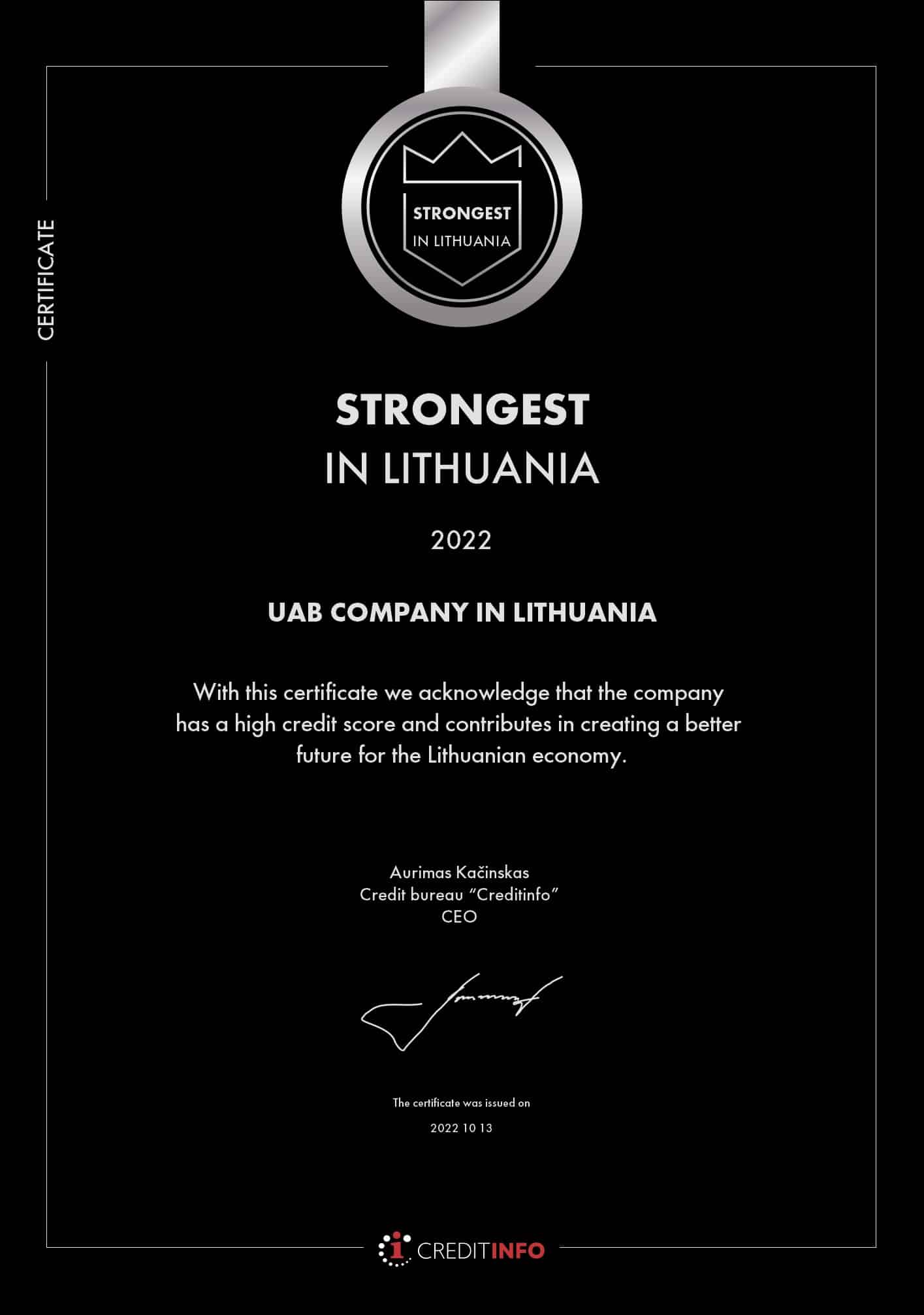
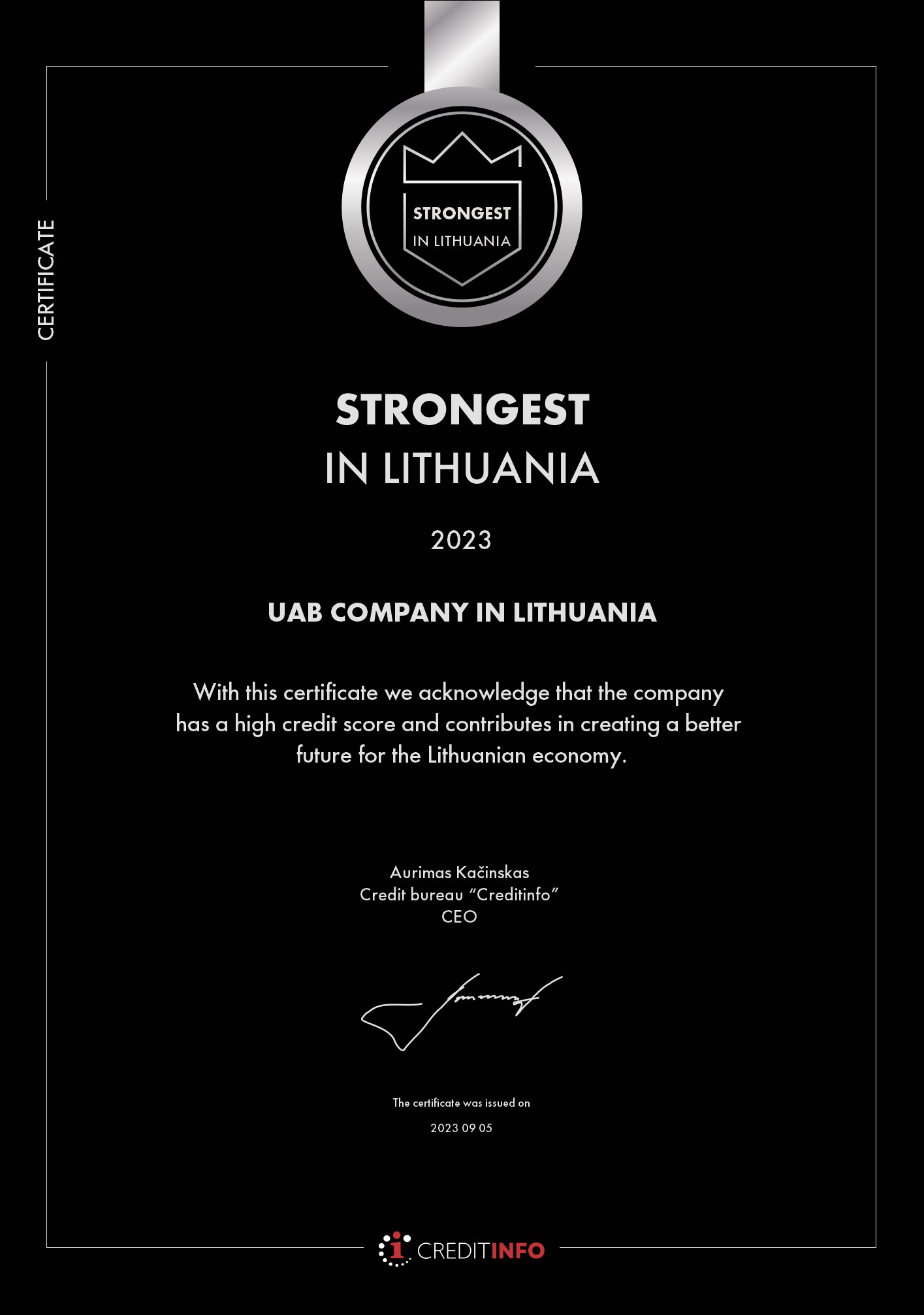

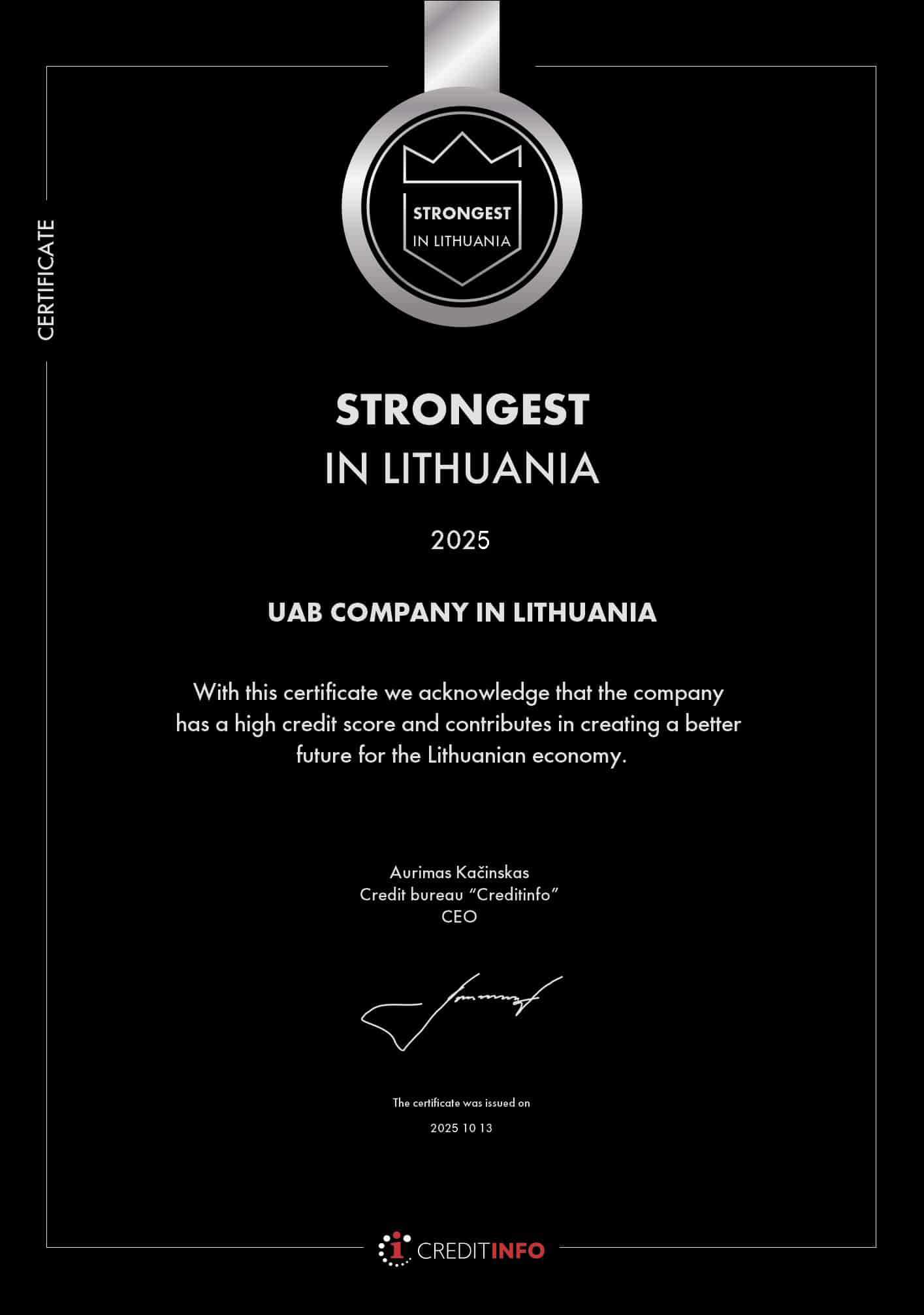
Company in Lithuania UAB has been recognised as one of Lithuania’s most trusted business services firms. Based on the independent economic data of 2025, we have been awarded the Strongest in Lithuania designation for four consecutive years — a testament to our financial stability, professional credibility, and the trust that our clients place in us.
We contribute to a transparent, well-functioning business environment in the Lithuanian Republic — and we bring that same standard of integrity to every client engagement.
Ready to start your business in Lithuania?Contact our team today for a personalized consultation. We are here to make the process simple, fast and hassle-free.Contact us
Popular services