
Lithuania is the largest, as well as the most populous, state among the Baltic countries. It is located on the Baltic Sea coast, a member of the Schengen Treaty and a member of the World Trade Organization. In recent years, Lithuania has made significant progress by attracting foreign capital to the economy of the country, mostly at the expense of cheap labour, a stable developing economy, low inflation, etc. A Lithuanian company can trade within the EU single market. Goods in free circulation generally move between EU Member States without customs duties, but VAT, product standards, licensing, excise duties and other applicable restrictions must still be observed.
As more and more promising entrepreneurial projects make their way into Lithuania, local authorities are working to ensure even possibilities for national and international players. That creates an environment which supports new initiatives and encourages collaborative growth – an environment of fast-growing international companies and start-ups that we see in Lithuania today. Attracting investment to Lithuania is one of the most important strategic goals of the State. To implement it, Lithuania constantly improves its image and its attractiveness among investors not only within the country, but also in relations with foreign States or individuals residing in foreign States.
Lower bar on immigration requirements
Business activity may provide a basis for a Lithuanian residence permit only where the applicant and the business meet the statutory requirements. Investing in or incorporating a company does not automatically confer residence rights. This decision was taken to encourage investment in business and has already attracted many foreigners who come to live here on the basis of legal activity. Foreigners have the right to join the management of the already established legal entity in Lithuania (to become shareholders of the enterprise) or to establish a new legal entity.
Simple establishment process
Equal opportunities also translate into new digitization projects and advanced, well-protected platforms that make it possible to submit the necessary paperwork on a remote basis.
Whereas some business owners may still choose to create a business by physically going to a state institution and filing the paperwork in person, there is another, significantly more efficient way to do it. To simplify the procedure and make it more accessible, Lithuania is offering a very convenient and reliable digital registration platform. Eligible companies may be incorporated electronically through the Centre of Registers. An accepted electronic signature is required, together with the applicable founding documents, registered-office consent and evidence of capital payment where required. The total timeframe depends on completing these requirements and resolving any registration deficiencies.
Other advantages
- Establishing a company in Lithuania grants access to an advantageous tax system.
- Lithuanian companies have a high reputation on the market as they are not offshore companies. This advantage makes it possible to be a reliable business partner, but also comes with certain tax benefits.
- All enterprises registered in Lithuania and having accounts with local banks do not have exchange control. This allows free movement of funds.
- Lithuanian companies may register for VAT voluntarily or must register when statutory conditions apply. Reverse charge or zero-rating applies only to qualifying transactions and requires compliance with the relevant VAT conditions; dealing with an EU partner alone is insufficient.
- Company formation does not automatically confer a right to a residence permit. A valid Lithuanian residence permit generally permits residence in Lithuania during its validity and short visits to other Schengen countries for up to 90 days in any 180-day period, subject to the applicable conditions.
Company formation
There are four main legal forms of companies in Lithuania, namely:
- Open Limited Company (AB), equivalent to a joint-stock company (JSC).
- A Closed Limited Liability Company (UAB), analogous to a Limited Liability Company (LTD).
- General partnership (TŪB) or limited partnership (KŪB).
- A branch or representative office of an existing company, neither of which is a separate legal entity.
The most common form among local and foreign citizens in Lithuania is the Closed Limited Liability Company (UAB).
Information about Lithuania
Lithuania is the most suitable country in the Baltic region to establish a business abroad, as it has a stable economy, a dynamically developing financial sector and low income tax rates.
To open a company in Lithuania means to expand your horizons and bring your business to a new level that meets international standards. The Republic of Lithuania ranks second in Europe in terms of investment attractiveness index and 11th in the world in terms of ease of starting a business, and has also risen to the 13th position in the ranking of the freest economies. The labor market is estimated at 1.5 million specialists.
The decision to register a company on the territory of the Republic of Lithuania is relevant for the formation of a transit point and further access to the European market, which includes 27 states, allowing you to multiply the number of potential customers and conduct your business more efficiently. An entrepreneur can also open a branch in any EU country.
The Republic of Lithuania is an attractive jurisdiction for obtaining a leave to remain in the expanses of Europe, as a result of which you will be able to move freely in the Schengen area without having to apply for a visa.
Lithuania’s tax system is loyal. It has some of the lowest tax rates in the entire European Union. For tax periods beginning in 2026, the standard corporate income tax rate is 17%. Eligible small entities with annual revenue not exceeding EUR 300,000 may apply a 7% rate, subject to statutory conditions and related-entity rules. The former 10-employee limit no longer applies. The VAT rate is 21%. In addition, an entrepreneur can use legal methods of tax exemption and gets the opportunity to avoid double taxation, since special agreements have been concluded with a large number of countries.
There is almost no currency control in Lithuania. The official currency is the euro. At the same time, payments can be made in any currency that is freely convertible.
Official documents are kept in Lithuanian and English.
TOP 14 reasons to open a company in Lithuania:
- A stable market economy
- Entering the European market (27 participating countries) and increasing the number of customers
- Opening a representative office in any European state
- Corporate income tax rates from 2026: 17% standard rate and 7% for eligible small entities
- Protection from double taxation
- Recovery of eligible input VAT, subject to the applicable deduction or refund conditions
- No currency control
- The possibility of applying for temporary residence where the statutory immigration requirements are met
- Short visits to other Schengen countries for holders of a valid Lithuanian residence permit, generally limited to 90 days in any 180-day period
- Trade within the European Union without customs barriers
- Business credit on preferential terms
- Registration in your name or company of motor transport
- Relatively low maintenance costs of a company
- Ease of communication and the spread of the English language
The registration of a company in Lithuania is accompanied by the provision of a legal address and the entry of details in the state register of the country.
Company registration forms in Lithuania
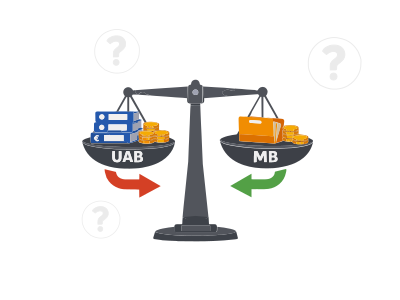
Starting your business, you initially need to decide on the legal form for the company. The most common forms of company registration in Lithuania are closed joint stock company, small company and individual enterprise. As evidenced by statistics, opening of a joint-stock company is considered to be the most convenient option.
A UAB (uždaroji akcinė bendrovė) is a commonly used private limited liability company. Its founders may be individuals or legal entities. There is no statutory maximum of 250 shareholders. Foreign participation is generally permitted, subject to applicable sanctions and sector-specific restrictions.
A UAB must have a general meeting of shareholders and a company manager, who must be an individual and may be a non-resident. A management board and supervisory board are generally optional. A collegial body does not replace the mandatory company manager.
The minimum share capital of a UAB is EUR 1,000. Before registration, each subscriber must pay the required initial cash contribution, generally at least one-quarter of the subscribed nominal value, and total initial contributions must be at least EUR 1,000. Any outstanding amount must be paid within the statutory subscription period, which cannot exceed 12 months. The authorized capital shall be formed by transferring funds from any bank, including a foreign account, as well as by depositing cash to the company’s savings account.
The main advantage of CJSC is limited liability to creditors. Shareholders and owners are not liable for their obligations with their personal property.
A statutory audit is generally required where at least two indicators exceed these thresholds: balance-sheet assets of EUR 2.5 million, annual net sales revenue of EUR 4.5 million and an average annual workforce of 50 employees. Other mandatory audit grounds include qualifying public funding or support exceeding EUR 500,000 and specified legal forms or public-interest status.
Legal forms that are less common:
Open Joint Stock Company (AB)
It can put shares up for public sale, and the number of shareholders is unlimited. An AB must have a general meeting of shareholders, a company manager and at least one collegial body: a supervisory board or management board. Its minimum share capital is EUR 25,000. Initial cash contributions must satisfy the statutory subscription requirements and together amount to at least EUR 25,000 before registration. Shares can be sold to any person, the consent of the shareholders’ meeting is not required.
Full Economic Partnership (TUB)
A company is opened on the basis of a contract by partners, the number of which ranges from 2 to 20. They bear unlimited liability for debts.
Limited Partnership (KUB)
A company is opened by partners (2-20 people) who bear different liabilities — unlimited liability or liability within the agreed amount.
Small Society (MB)
This legal form has appeared recently and is not too widespread yet. The amount of contributions is not established by law, and it is determined by the members of the society themselves, which can be from 1 to 10. Members generally are not personally liable for the MB’s obligations, except where statutory grounds for personal liability apply.
Individual enterprise
A company is owned by a single owner. There are no requirements for the amount of the authorized fund. However, the owner bears full personal financial liability for the results of the activity.
Documents required for company registration in Lithuania
A full-fledged company in Lithuania is a structure that has been registered with the tax authority, is listed in the state register and has a bank account opened with a local bank.
Documents for company registration with your presence:
- Copies of valid identity documents; a Lithuanian residence permit is not generally required merely to establish a company
- Home address
- Company name
- Type of activity
Documents for company registration without your presence:
- Copies of valid identity documents; a Lithuanian residence permit is not generally required merely to establish a company
- Home address
- Company name
- Type of activity
- Power of attorney for company registration
During the opening of the company in Lithuania, an extract on the deposit to the fixed capital account will also be required.
After registering a company with the Lithuanian state authorities, you will receive a full package of documents.
Certain activities require a Lithuanian licence, authorisation or registration. Permission to operate in another EU country depends on the sector and any applicable passporting or recognition procedure. A Lithuanian licence is not automatically valid throughout the EU. The following are subject to licensing in Lithuania: restaurant and gambling business, tourism, investment activity, alcohol and antiques trade, construction, pharmaceuticals.
Contact our specialists for detailed advice regarding the choice of the company registration form, licensing of the company’s activities.
The procedure for registering a company in Lithuania
The conditions for registering a new company in the territory of the Republic of Lithuania are the same for residents and non-residents. Foreign residents may generally establish a Lithuanian company, subject to applicable sanctions, identity verification, sector-specific restrictions and any national-security screening requirements.
A step-by-step process of registering a company in Lithuania:
- Selection of a unique company name. First of all, you need to decide on the name of your company. If this is a sole proprietor, then you can use your surname with initials. In case of registration of a legal entity, any word written in Latin letters will do. It must comply with the rules of the Lithuanian language. This is monitored by the State Commission for the Lithuanian Language. As a result, the applicant is granted permission to use a specific name.
- Opening a bank account. For a UAB or AB, open an accumulative account with an eligible credit or electronic money institution to pay the required initial capital contributions. The Bank of Lithuania, as the central bank, does not provide ordinary company incorporation accounts. It is absolutely necessary to obtain a certificate of deposit of a sum of money, as it is subsequently required to attach it to the application for registration of a company in Lithuania.
- Choosing a legal address. The presence of a registration office in the Republic of Lithuania is mandatory. Official documents will be sent to this address. Correspondence is considered received by a company if the sender specifies the office address.
- Preparation of constituent documentation. All necessary documents shall be drawn up in Lithuanian. Translations must meet the requirements of the receiving authority. Lithuania does not have a general system of sworn translators, and there is no universal requirement to use a translator located in Lithuania. If a foreign company acts as the founder, all the statutory documentation should be translated into Lithuanian. A charter, a constituent agreement, and the minutes of the first shareholders’ meeting shall be prepared as constituent documents. If the founder is one person, then an act and a decision on opening an enterprise in Lithuania are drawn up instead of a constituent agreement and minutes. Notarial formalities depend on the incorporation route and the documents involved. Eligible electronic incorporation through the Centre of Registers can be completed without notarisation.
- Payment of share capital. The subscribers pay the required initial cash contributions before registration, together amounting to at least the statutory minimum capital. Any outstanding subscription amounts must be paid within the agreed statutory period, not exceeding 12 months. Non-cash contributions are subject to valuation and other legal requirements and cannot replace the mandatory initial cash contributions. An ordinary incorporation does not require a brokerage certificate confirming the founders’ acquisition of shares. The incorporation documents depend on the legal form and incorporation route. Ordinary UAB incorporation does not require a securities certificate or a state auditor’s opinion on an initial financial report.
- Registration of the company in the register of legal entities. After preparing the necessary documents, an application for company registration shall be filled in. If there are no complaints from the state body, information about it shall be entered in the register of enterprises. For a UAB or AB, the company manager must be appointed before registration, and the appointment details must be included in the registration documents.
- Registration with the Social Insurance Fund and the tax inspectorate. A Lithuanian legal entity is automatically entered in VMI’s Register of Taxpayers using information from the Register of Legal Entities. Additional tax details and employer notifications must be submitted where required. VAT registration and employee reporting are separate obligations with their own deadlines.
- Re-registration of a savings account into a settlement account. Before registering a company in Lithuania, an accumulative bank account is opened, to which the authorized capital is deposited. After incorporation, apply for conversion into a current account or opening of a separate current account. Approval and any requirement for an in-person visit depend on the provider’s procedures and customer due diligence.
Buying a ready-made company in Lithuania
Acquisition of a ready-made registered company will be the fastest approach to opening a company in Lithuania. You can easily avoid bureaucracy, immediately engage in the implementation of your activities and making a profit.
Also, the purchase of a company with an existing name will be of interest to customers already operating in their country who want to enter the EU market and create a company with a similar name.
The process of re-registration of the company to a new owner is associated with updating the data in the Register Center. Despite the fact that the procedure will take some time, you can start working and doing business after a couple of days, after the purchase of the company is made.
All ready-made companies are guaranteed to come with pre-registration, a clean balance sheet and a minimum authorized capital of 1,000 euros. Thus, the client does not incur additional costs.
Together with the current company and the constituent documents, the new owner receives a legal address for 1 year.
Foreign companies registered in Lithuania are payers of taxes on all income. Cash receipts from doing business within the country and outside the Republic of Lithuania are taken into account. If a double taxation treaty has been concluded between the states, exemption from basic taxes is possible.
Lithuania’s tax system is very flexible, the rates are among the lowest in Europe:
- For tax periods beginning in 2026, corporate income tax is generally 17%. Eligible small entities with annual revenue not exceeding EUR 300,000 may apply 7%. Eligible newly registered small entities may apply 0% for their first two tax periods, subject to all statutory conditions. The former 10-employee limit no longer applies;
- The standard VAT rate is 21%. From 2026, reduced rates of 12% and 5% apply to specified supplies, including 12% for qualifying passenger transport and 5% for qualifying books and non-periodical publications. Zero-rating applies only to transactions meeting the statutory conditions; domestic transport is not generally zero-rated;
- From 2026, personal income tax on employment income generally follows annual bands of 20%, 25% and 32%. Other income categories may have separate rates or calculation rules;
- Dividend tax is 15%.
In 2026, employee social and health insurance contributions generally total 19.5%, with an additional 3% pension contribution where applicable. The standard employer contribution is generally 1.77% for an indefinite employment contract in the lowest accident-risk category; higher rates apply to fixed-term contracts and other risk categories.
An agreement on avoidance of double taxation has been signed with 53 countries. Qualifying companies in Lithuania’s free economic zones may benefit from corporate income tax relief. Eligible companies registered after 31 December 2017 may receive a 10-tax-period exemption followed by six tax periods at a 50% reduced rate, subject to investment, revenue, employment and state-aid conditions. This does not exempt them from all taxes.
A company in the Republic of Lithuania can be registered remotely without the presence of the founder. A power of attorney and information for legal documents will be required from your side. Please contact our specialists for additional advice!
Accounting reporting in Lithuania is mandatory. A balance shall be handed over annually. You need to submit a report on accrued and paid wages monthly.
The director may entrust the organization of the company’s accounting to a full-time accountant or outsource it to a third-party company that will compile reports based on data on the company’s activities.
Leave to remain in Lithuania
Doing business in the Republic of Lithuania by a foreign citizen allows you to obtain a temporary leave to remain in compliance with a number of basic requirements:
- For the ordinary business-based residence route, the applicant must meet the statutory participation or management requirements. The company generally must have equity of at least EUR 28,000, including at least EUR 14,000 invested by the applicant; the one-third shareholding requirement applies where relying on qualifying share ownership;
- The company must have genuinely carried out its stated activities in Lithuania under a business plan for at least the preceding six months; registration alone is insufficient;
- The company must meet the statutory full-time employment and aggregate salary requirements. Qualifying employees may include Lithuanian, other EU or EFTA citizens and foreign nationals permanently residing in Lithuania. Their combined monthly gross salaries must meet the applicable statutory threshold.
Contact Company in Lithuania UAB and get a price offer for opening a company in Lithuania.