
Depending on your chosen business sector, you may benefit from such advantages as:
- One of the fastest company registration processes in the EU which saves you money and time.
- Vast availability of online services enabling you to carry out business activities and implement necessary procedures remotely.
- Strategic geographical position – right in the centre of Europe – ideal for distribution of goods.
- Four international airports that make the country easily accessible.
- Lithuania has a well-developed digital infrastructure, including extensive broadband connectivity, modern telecommunications networks and access to electronic government services. The country offers favourable conditions for technology companies, digital businesses and remote operations. However, internet speed and cybersecurity rankings change over time and should be supported by recent comparative data rather than historical rankings.
- A pool of multilingual, motivated and highly skilled talents who are eager to drive businesses forward.
- Ease of paying taxes to the Lithuanian government provides you with peace of mind, much needed for the successful development of your business.
If you’re convinced that Lithuanian business environment is promising for you, read on to learn about the different ways of becoming a company owner in Lithuania.
Establishing a New Business in Lithuania
Opening a completely new company remains one of the most popular ways to realise a business idea in Lithuania. The benefits of starting from scratch include relatively low set up costs, no unclear trading history, no debts as well as freedom to define every operational principle.
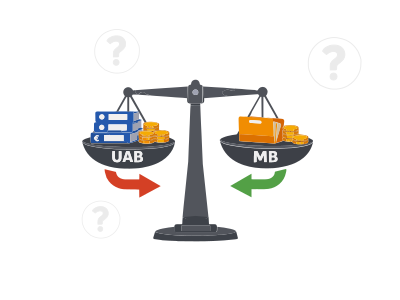
Setting up a new company in Lithuania is fairly easy if you have all the required documentation prepared for the process. Registering a Lithuanian company may take only a few business days once all incorporation documents have been properly prepared and submitted. However, opening a corporate bank or payment account is a separate process involving customer identification, beneficial ownership verification, anti-money laundering checks and the financial institution’s internal approval procedures. Account opening may take considerably longer, particularly for foreign-owned companies. Businesses operating in regulated sectors must also obtain the necessary licences, permits or registrations before commencing the relevant activities. Prior to registering it, you’ve got to decide what type of legal entity suits you best. The most common legal entities in Lithuania are Private Limited Liability Company (UAB), Public Limited Liability Company (AB), Small Partnership (MB) and Individual Enterprise (IĮ). Our knowledgeable experts here at Company in Lithuania UAB are more than happy to consult you on the best options available for your business idea.
Once you’ve decided on the type of the company, you should determine all the requirements and permits related to the specific business sector (e.g. construction, catering or kindergarden). Information about business establishment, sector-specific regulatory requirements, available support programmes and entrepreneurship services can be obtained from Lithuania’s Innovation Agency (Inovacijų agentūra). Established in 2022, the Innovation Agency incorporated the functions of the former Enterprise Lithuania (Versli Lietuva) and other business support institutions. Businesses operating in regulated sectors should also verify licensing and authorisation requirements directly with the competent Lithuanian authorities. This will prevent you from different kinds of regulatory friction when carrying out economic activities.
The procedure for establishing a Lithuanian company depends on its legal form, ownership structure and method of incorporation. For a private limited liability company (UAB), the process generally involves preparing the founding documents, selecting and registering the company name, providing a registered office address, arranging the required share capital and submitting the incorporation documents to the Lithuanian Register of Legal Entities. Certain steps, including capital contributions and document certification, differ for other legal forms such as a Small Partnership (MB), which has no statutory minimum share capital requirement.
- Preparation of articles of association along with founding act/founding agreement
- Reservation of a temporary company name
- Opening of an accumulative bank account
- Transfer of share capital to the bank account
- Notarial certification of incorporation documents where required by law. A Lithuanian UAB or MB may be established electronically through the Centre of Registers without visiting a notary, provided that the applicable requirements for electronic identification, qualified electronic signatures, standard founding documents and other registration conditions are satisfied.
- Registration of the company at the State Enterprise Centre of Registers
- Conversion of the accumulative bank account into a settlement account
- Obtaining a qualified electronic signature or another accepted electronic identification method where required for online incorporation and subsequent electronic filings. Electronic signatures are also widely used for corporate reporting, shareholder information submission to JADIS, beneficial ownership reporting through JANGIS and communications with Lithuanian public authorities. A qualified electronic signature is not limited to the initial company registration process.
Buying an Off-the-Shelf Company in Lithuania
Off-the-shelf company is a pre-registered company with no trading history, normally run by a company formation agent until it gets sold and transferred over to a client (new owner). Acquisition of such a ready-made company generally costs more than starting a new business, but it also boasts such benefits as saving time and efforts needed for business establishment procedures in Lithuania. An established incorporation date may be relevant in certain commercial relationships. However, purchasing an older ready-made company does not automatically establish the operational experience, financial capacity or technical qualifications required for public procurement contracts. Under Lithuanian and EU public procurement legislation, contracting authorities generally assess the bidder’s actual eligibility, economic and financial standing, and technical and professional capacity. A company without a genuine operating history may not satisfy experience-based procurement requirements merely because it was incorporated several years earlier.
If you’ve decided that acquiring a ready-made company is the right path for your business in Lithuania, the next step to take is to find a reliable agent who trades such legal entities. Company in Lithuania UAB will be pleased to assist you with the search as well as with the remote re-registration procedure of an off-the-shelf company of your choice.
Following the acquisition of a Lithuanian ready-made company, the new shareholder may exercise ownership rights once the share transfer has been validly completed in accordance with the applicable legal requirements. Notarial certification is generally required for the sale of 25% or more of a UAB’s shares or where the transaction price exceeds EUR 14,500, subject to statutory exceptions. Changes to the company’s director, registered office, shareholder information and beneficial ownership must be completed through the appropriate corporate procedures and reported to the relevant registers, including JAR, JADIS and JANGIS. Any regulated business activities may commence only after the required authorisations have been obtained.
Buying an Existing Company in Lithuania
Buying a company that already has a trading history is a fast yet risky move as you would be adopting someone else’s legacy, which must be examined carefully prior to making the decision. If chosen successfully, an existing company can present huge advantages that are normally gained with time and through a considerable effort.
The following advantages might be at stake:
- Start-up stage with all its challenges is omitted as a huge portion of the foundational work is done, which should allow you to focus on further business development.
- An established business has a proven record of economic activities, which simplifies securing financial support.
- A reputable company will have a base of clients, contacts and a trusted public profile which is important for continuous marketing efforts.
- The company’s operations will be maintained by the existing experienced employees.
The acquisition of an existing Lithuanian company involves legal and financial due diligence, execution of a valid share purchase agreement and completion of applicable corporate and registry formalities. Notarial certification is generally required for the sale of 25% or more of a UAB’s shares or where the transaction price exceeds EUR 14,500, subject to statutory exceptions. Shareholder changes must be reported to JADIS, while changes in ultimate beneficial ownership must be submitted to JANGIS. Changes concerning directors, the registered office or other information maintained in the Register of Legal Entities (JAR) must be registered separately where applicable. Although the share purchase agreement may be executed within one business day, the complete acquisition and registration process may take longer.
Whichever way of starting a business in Lithuania you choose, Company in Lithuania UAB will help you to set the stage for your success by providing comprehensive legal advice on company formation, transfer, taxation as well as by offering professional financial accounting services. Contact our dedicated experts today for a tailored consultation.
Additionally, we offer a virtual office service which eliminates the need for expensive office leases, equipment and staff. It’s an advantageous solution for small businesses who are willing to create a professional image by having access to such physical office functions as a business address, meeting facilities and reception, while at the same time reducing costs and maintaining the benefits of remote work. Enquire about our virtual office here.