Business Services by Industry

AT A GLANCE

  1. We provide corporate, accounting, legal, and compliance services tailored to five key industries — startups, fintech, e-commerce, SaaS, and foreign investors.
  2. Each industry page combines the specific services most relevant to that sector — accounting, legal, compliance, recruitment, and regulatory support.
  3. Industry-specific knowledge matters: a fintech company has different compliance obligations, different accounting requirements, and different legal risks than a SaaS business or an e-commerce retailer.
  4. All services are delivered in English by one team — eliminating the coordination gap between separate providers handling different parts of your business.
  5. Select your industry below to see the exact services, obligations, and considerations that apply to your type of business in Lithuania.

The services required to run a Lithuanian company correctly depend heavily on what the company does. A fintech startup applying for an EMI licence needs AML compliance documentation, regulatory advisory, and fit-and-proper governance from day one. An e-commerce business needs EU VAT compliance and customs knowledge. A SaaS company needs GDPR and data protection frameworks. We organise our service offering by industry so you can see immediately what is relevant to your business — without filtering through services that do not apply.

Why Industry-Specific Services Matter

Lithuanian corporate, accounting and tax requirements depend on a company’s legal form, size, activities, tax status and applicable regulatory framework. Different types of companies may be subject to different financial reporting, audit, taxation and governance obligations. Additional requirements concerning licensing, compliance, contracts and regulatory supervision vary according to the industry and the specific activities carried out.

A foreign investor registering a holding company to receive dividends from an existing business needs a clean structure, a competent accountant, and clear transfer pricing documentation. A fintech founder applying for an EMI licence needs all of that plus an AML policy, a compliance officer, a capital adequacy plan, and a Bank of Lithuania that is satisfied with the governance structure before the licence is granted. The underlying company registration is the same. Everything that follows it is not.

We have structured our industry pages to reflect this reality. Each page maps the services most relevant to that sector, explains the specific regulatory context, and describes what a company in that industry typically needs at each stage of its lifecycle in Lithuania — from first registration through to ongoing operations and, where applicable, regulatory authorisation.


Choose Your Industry

Select the industry that best describes your business. Each page provides a complete picture of the services, compliance obligations, and practical considerations specific to that sector in Lithuania.

Startups · Company registration, accounting, and legal foundations — built right from the start

Early-stage companies have a narrow window to establish the right legal and financial structure before the complexity of growth makes it harder and more expensive to fix. A Lithuanian startup that registers with the wrong articles of association, skips VAT registration, or uses informal contractor arrangements faces avoidable problems within the first 12 months. We handle the full setup — registration, accounting, employment contracts, and legal structure — so founders can focus on building rather than on Lithuanian administrative law.

Services on this page:

  • Accounting for start-ups — bookkeeping, VAT, payroll from day one
  • Legal services for start-ups — contracts, IP protection, shareholder agreements
  • Startup legal structuring — entity choice, founder agreements, vesting schedules
Fintech · Licensing, compliance, and regulatory advisory for payment and financial services companies

Lithuania is one of the most accessible EU jurisdictions for fintech licensing. The Bank of Lithuania has issued more EMI and payment institution licences than most other EU regulators, and the regulatory framework for MiCA-compliant crypto businesses is established and functioning. But accessible does not mean simple. Licence applications require extensive documentation, demonstrated capital adequacy, robust AML/KYC frameworks, and governance structures that satisfy fit-and-proper criteria. We support fintech companies from initial structure through to licence approval and ongoing regulatory compliance.

Services on this page:

  • Accounting services for fintech — specialist bookkeeping for licensed entities
  • Legal services for fintech — regulatory contracts, terms of service, licence conditions
  • Compliance services for fintech — AML/KYC policy, internal controls, MLRO support
  • Recruitment services for fintech — compliance officers, AML analysts, tech staff
  • Outsourcing services for fintech — CFO, compliance, and legal on a retainer basis
  • Regulatory advisory — EMI, PI, MiCA licence strategy and Bank of Lithuania liaison
  • Compliance documentation drafting — AML policy, risk assessments, procedure manuals
E-commerce · VAT compliance, legal framework, and cross-border trade support for online retailers

E-commerce businesses selling to EU consumers face a complex VAT landscape that has changed significantly since the introduction of the EU One Stop Shop (OSS) scheme in 2021. A Lithuanian entity selling cross-border across the EU needs the right VAT registration strategy from the outset — including whether OSS registration is appropriate, when individual country registrations are required, and how to handle import VAT for goods entering the EU from non-EU suppliers. Beyond VAT, e-commerce companies need correctly drafted terms and conditions, returns policies, consumer protection compliance, and payment gateway arrangements that satisfy both Lithuanian and EU law.

Services on this page:

  • Accounting services for e-commerce — OSS VAT reporting, multi-currency bookkeeping
  • Legal services for e-commerce — terms and conditions, returns policy, GDPR compliance
  • Customs & import/export compliance — import VAT, customs classification, IOSS registration
  • Payment gateway compliance advisory — PSP agreements, chargeback procedures, PCI-DSS
SaaS · Data protection, legal documentation, and IP structuring for software companies

Software-as-a-service businesses operating from Lithuania face a specific set of legal and compliance obligations that do not apply to other sectors. GDPR governs how they process personal data of EU users — and non-compliance carries fines of up to 4% of global annual revenue under EU enforcement. SaaS contracts with business clients need carefully drafted data processing agreements that correctly allocate liability. Terms of service need to be compliant with both Lithuanian consumer protection law and EU digital services regulations. For SaaS companies that hold intellectual property — software code, algorithms, databases — Lithuania offers a favourable IP box regime that we can help structure correctly.

Services on this page:

  • Accounting services for SaaS — subscription revenue recognition, deferred income treatment
  • Legal services for SaaS — SaaS agreements, DPAs, acceptable use policies
  • Outsourcing services for SaaS — virtual CFO, legal retainer, compliance advisory
  • Data protection & GDPR compliance — privacy policies, DPAs, data breach procedures
  • Terms of service & privacy policy drafting — EU-compliant, enforceable documentation
Foreign Investors · EU market entry, holding structures, and ongoing corporate support for international investors

Foreign investors entering the Lithuanian and EU market through a Lithuanian entity need more than a registered company. They need a structure that works — for tax efficiency, for regulatory compliance, for banking, and for the specific commercial activities they plan to run. A holding company receiving dividends from an operating subsidiary has different needs from an investor establishing a Lithuanian operating company from scratch. We advise on the right structure at the outset and provide the accounting, legal, and corporate services to maintain it correctly.

Services on this page:

  • Accounting services for foreign investors — group accounting, transfer pricing, dividend reporting
  • Legal services for foreign investors — investment agreements, corporate governance, M&A support
  • Immigration services for foreign entrepreneurs — work permits, residence permits, EU Blue Card

Services by Industry — Overview

The table below shows which services are most commonly required by each industry type. This is a general guide — the exact scope for your company depends on your specific activities, structure, and regulatory status. Each industry page provides a more detailed breakdown.

Service Startups Fintech E-commerce SaaS Foreign Investors
Accounting & bookkeeping ✓ ✓ ✓ ✓ ✓
Payroll & HR administration ✓ ✓ ✓ ✓ —
VAT registration & returns ✓ ✓ ✓ ✓ ✓
EU OSS / IOSS VAT reporting — — ✓ ✓ —
Corporate income tax filing ✓ ✓ ✓ ✓ ✓
Transfer pricing documentation — ✓ — — ✓
Employment contracts & Labour Code ✓ ✓ ✓ ✓ —
Shareholder & founder agreements ✓ ✓ — ✓ ✓
AML / KYC policy & compliance — ✓ — — —
Regulatory licence advisory — ✓ — — —
GDPR & data protection ✓ ✓ ✓ ✓ —
Terms of service & privacy policy — ✓ ✓ ✓ —
Customs & import/export compliance — — ✓ — —
Payment gateway compliance — ✓ ✓ — —
IP structuring & protection — — — ✓ ✓
Immigration & work permits ✓ ✓ — ✓ ✓
Recruitment support ✓ ✓ — ✓ —
Compliance documentation drafting — ✓ — — —

Why Lithuania for Your Industry

The choice of EU jurisdiction matters — particularly for fintech, e-commerce, and SaaS businesses where the regulatory framework, banking infrastructure, and tax treatment of specific activities create meaningful differences between member states. Lithuania’s advantages are sector-specific as well as general.

For fintech and payment companies

Lithuania has developed an established financial technology sector, particularly in electronic money and payment services. The Bank of Lithuania supervises authorised Electronic Money Institutions (EMIs) and Payment Institutions (PIs) under the applicable Lithuanian and EU regulatory frameworks. Licensing applications are assessed individually against requirements concerning initial capital, governance, management suitability, safeguarding of client funds, operational infrastructure and AML/CFT compliance. The duration of authorisation depends on the completeness and complexity of the application. Claims concerning Lithuania’s ranking by number of licences or comparative licensing speed should be supported by current, comparable regulatory statistics. For companies seeking an EMI or payment institution licence that allows them to operate across the EU under a single authorisation, Lithuania is the most practical entry point.

For crypto and blockchain businesses

Lithuania regulates crypto-asset services under Regulation (EU) 2023/1114 (MiCA), which has generally applied to Crypto-Asset Service Providers (CASPs) since 30 December 2024. Lithuania’s transitional period for previously registered Virtual Asset Service Providers (VASPs) ended on 31 December 2025. Since 1 January 2026, national VASP registration no longer provides authorisation to conduct regulated crypto-asset services. Companies must generally obtain CASP authorisation from the Bank of Lithuania or qualify for an applicable exemption or notification procedure, including Article 60 of MiCA for certain authorised financial institutions. The Financial Crime Investigation Service (FNTT) retains relevant AML/CFT functions within its statutory competence. We assist with CASP authorisation applications, regulatory compliance and related corporate requirements.

For e-commerce businesses

Lithuania’s membership in the EU Single Market allows eligible e-commerce businesses to sell goods and services to consumers across EU Member States, subject to applicable VAT, consumer protection and product compliance requirements. The EU One Stop Shop (OSS) scheme simplifies VAT reporting for qualifying cross-border B2C transactions through a single Member State of identification. However, OSS does not eliminate every obligation to register for VAT in another Member State, particularly where a company holds stock, makes domestic supplies outside the scope of OSS or carries out other transactions requiring local registration. Lithuania’s standard VAT rate is 21%. Cross-border operations involving non-EU countries are subject to separate customs, trade, sanctions and tax requirements.

For SaaS and technology companies

Lithuania has a growing technology talent pool — particularly in Vilnius and Kaunas — with competitive salaries relative to Western European markets. For SaaS companies that need Lithuanian-based engineers, product managers, or data specialists, the employment market is accessible and the Labour Code framework is manageable with the right legal support. Lithuania’s IP box regime allows qualifying intellectual property income to be taxed at a reduced effective rate, which we structure correctly for SaaS companies holding their IP through a Lithuanian entity.

For foreign investors and holding structures

Lithuania’s participation dividend exemption — which allows dividends received by a Lithuanian holding company from qualifying subsidiaries to be exempt from Lithuanian corporate income tax under certain conditions — makes Lithuania a viable holding jurisdiction for multi-entity EU structures. Combined with the 55+ double taxation treaty network and the country’s membership in the EU and OECD, a Lithuanian holding company can be an efficient intermediate between a non-EU parent and EU operating subsidiaries. We advise on holding structure design as part of our tax law service.

Frequently Asked Questions

Not sure which industry page applies to you?

Contact us directly. We will ask you three questions — what your company does, who your clients are, and what your plans are for the Lithuanian entity — and tell you exactly which services apply and what the setup will involve. We respond within 24 business hours.

Was this page helpful? Rate it
Be the first to rate this page
Company in Lithuania UAB partners

Company in Lithuania UAB collaborates with a network of trusted partners across legal, financial, accounting, and business consulting sectors. Our strategic partnerships enable us to provide clients with end-to-end solutions for company registration, tax advisory, banking setup, and beyond — all under one roof, right here in Lithuania.

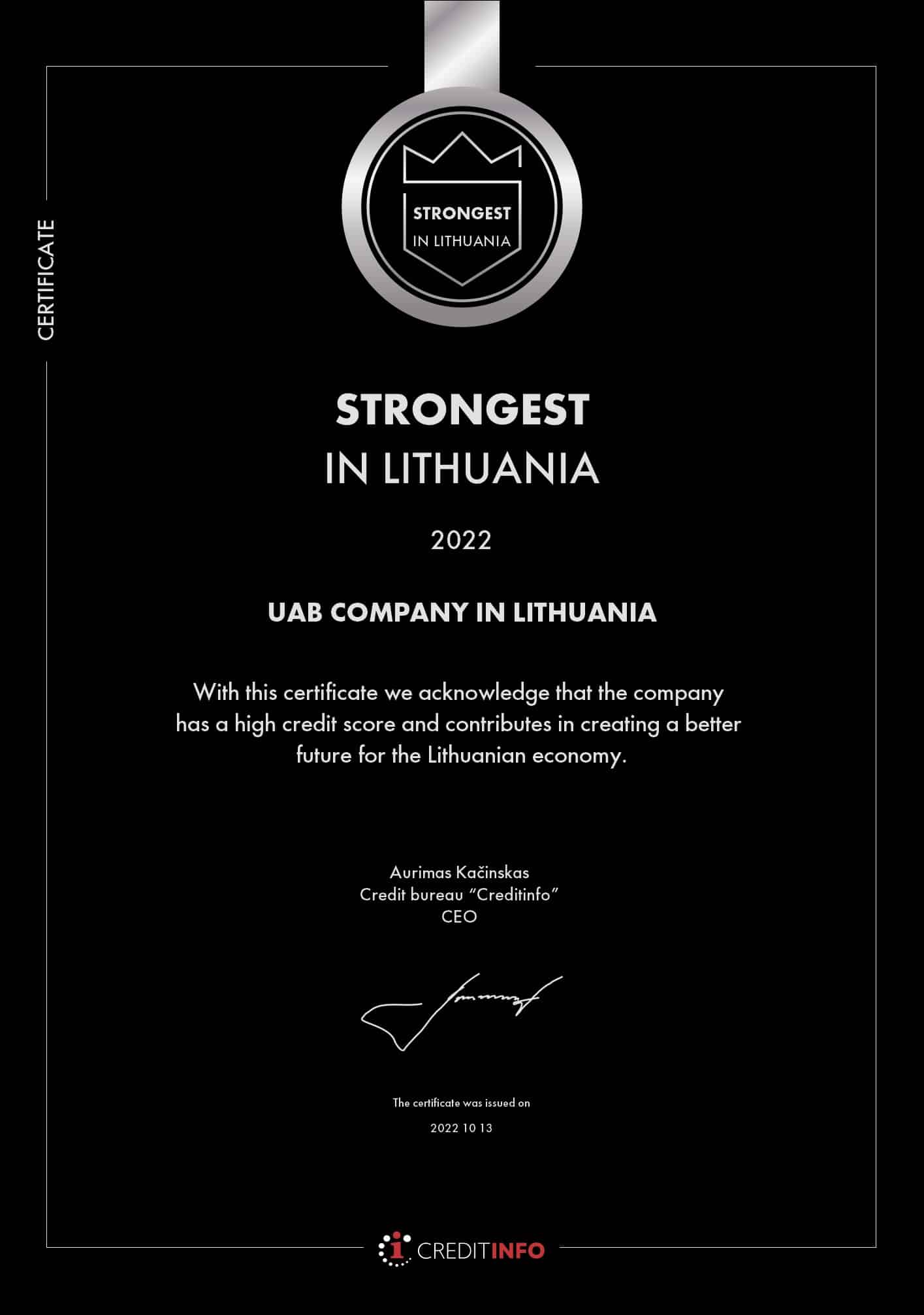
Strongest in Lithuania
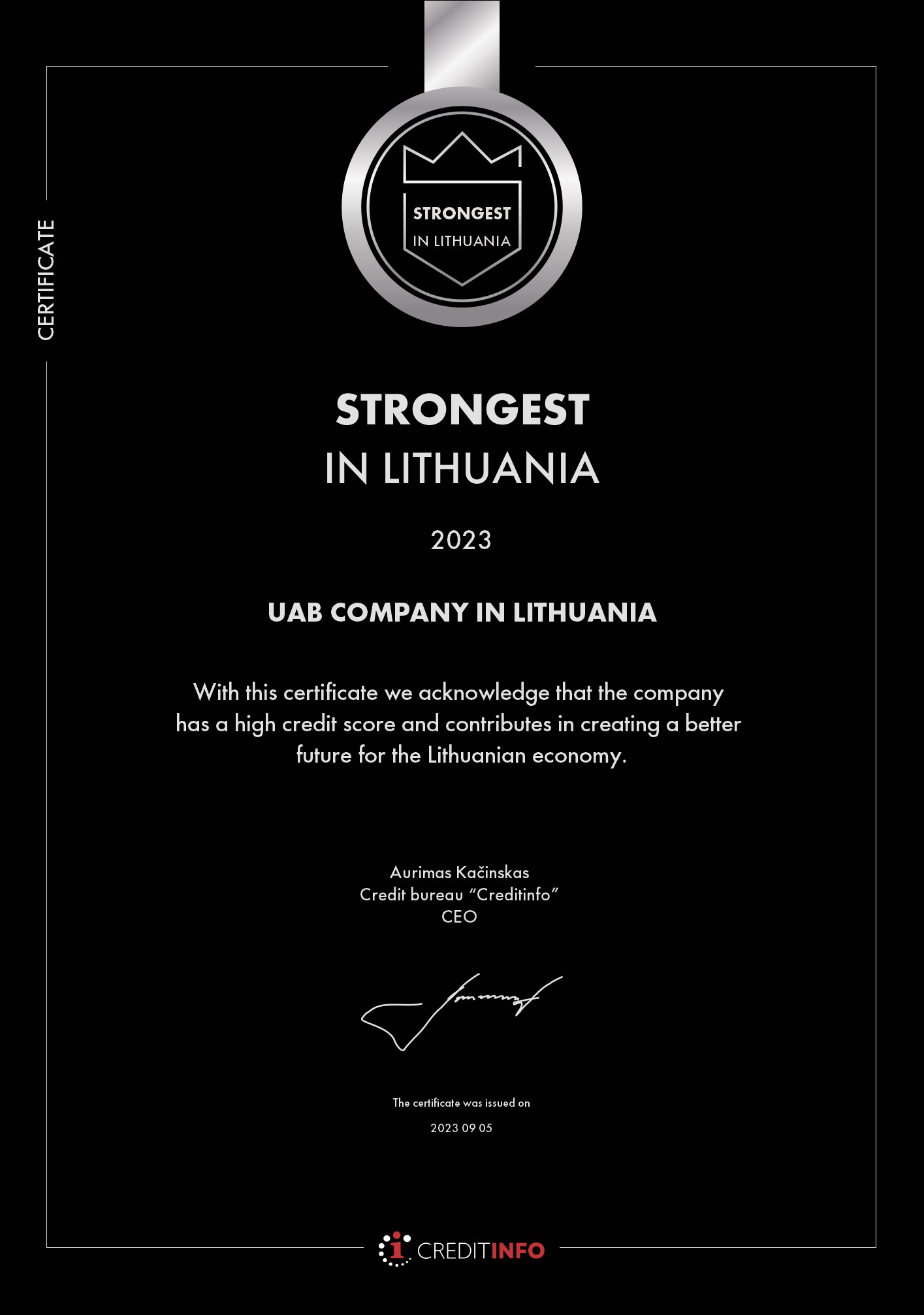
Strongest in Lithuania 2023
2024
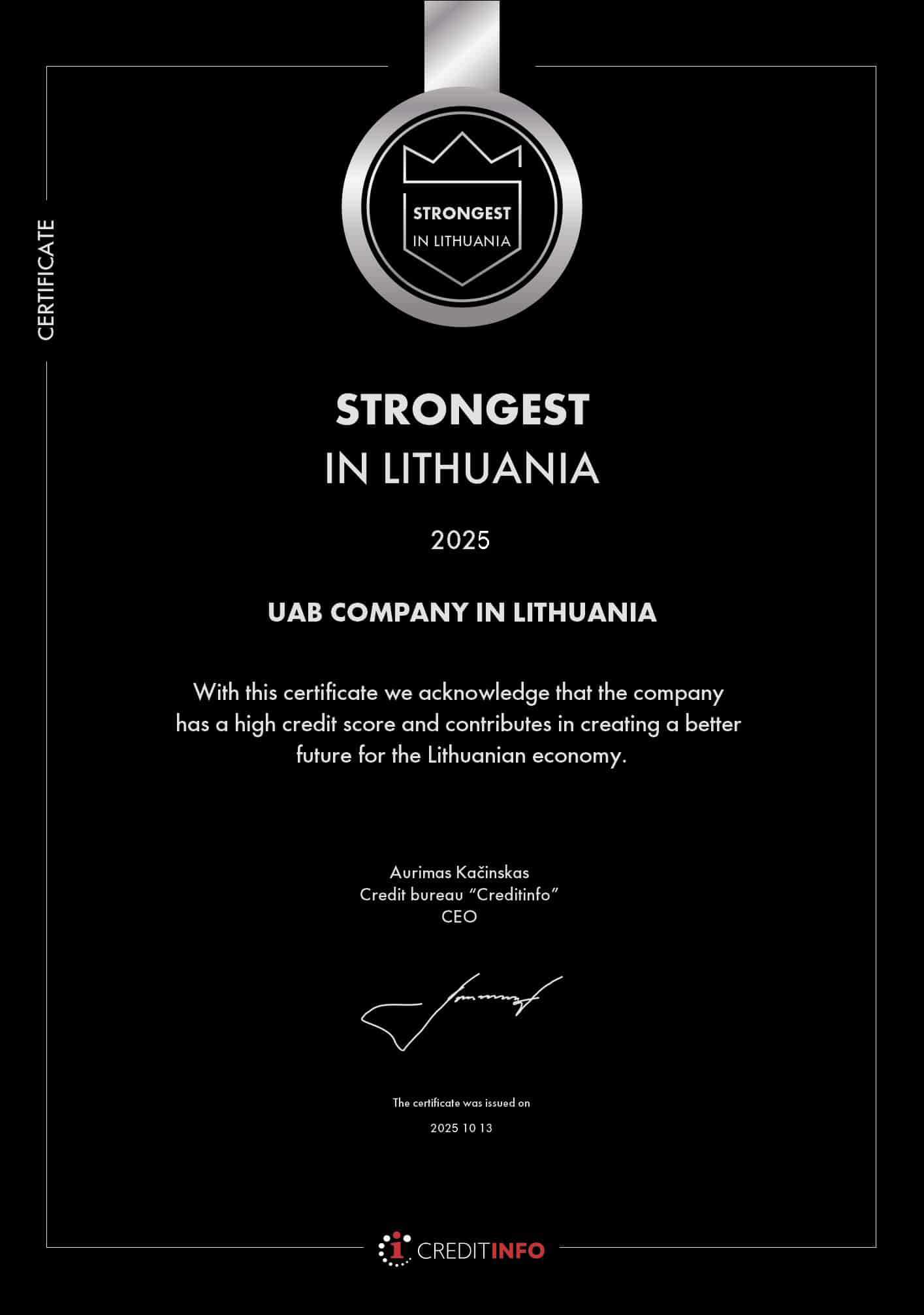
2025

Company in Lithuania UAB has been recognised as one of Lithuania’s most trusted business services firms. Based on the independent economic data of 2025, we have been awarded the Strongest in Lithuania designation for four consecutive years — a testament to our financial stability, professional credibility, and the trust that our clients place in us.

We contribute to a transparent, well-functioning business environment in the Lithuanian Republic — and we bring that same standard of integrity to every client engagement.

Ready to start your business in Lithuania?Contact our team today for a personalized consultation. We are here to make the process simple, fast and hassle-free.Contact us
Menu
Company in Lithuania
Privacy overview

This website uses cookies so that we can provide you with the best possible user experience. Cookies are small text files stored in your browser. Strictly necessary cookies are always on; analytics and marketing cookies are used only with your consent.

More information: Cookie Policy, Privacy Policy.