Electronic Money Institution (EMI) License in Lithuania

Market participants who have the right to issue electronic money are e-money institutions regulated by the Bank of Lithuania. Payments can be made with electronic money that is stored on electronic devices and issued by an electronic money institution. Besides transferring money (directly and credit), making payments, and obtaining cash withdrawals, an e-money institution can also make money transfers.

Electronic Money Institutions holding a full licence issued by the Bank of Lithuania may provide authorised electronic money and payment services in other EU/EEA Member States through the applicable passporting and notification procedures. Cross-border activities must fall within the scope of the institution’s authorisation and comply with applicable regulatory requirements. A full EMI licence does not automatically authorise every type of financial service or eliminate the need to complete the prescribed cross-border notification procedures. Restricted EMI licences are valid only within Lithuania and do not provide EU/EEA passporting rights.

The primary distinction between an Electronic Money Institution (EMI) and a Payment Institution (PI) is that an EMI is authorised to issue electronic money, while a PI is generally authorised to provide payment services without issuing electronic money. Both types of institutions may receive and hold client funds in connection with their authorised activities and must comply with applicable safeguarding requirements. Neither an EMI nor a PI is generally authorised to accept deposits from the public in the same manner as a licensed bank.

The Electronic Money Institution’s largest market share holders:

contis
walletto
transfergo

The main stages of application for an EMI licence in Lithuania

  • The applicant submits the EMI authorisation application and supporting documentation to the Bank of Lithuania, which assesses the completeness and regulatory adequacy of the application.
  • Under Lithuanian legislation, a decision on an EMI licence must generally be made within three months after the Bank of Lithuania receives a complete application containing all required information. Where additional information or corrections are requested, the relevant assessment period is calculated according to the applicable statutory rules.
  • The Bank of Lithuania, rather than the applicant or the EMI itself, decides whether to grant or refuse authorisation. The actual duration of the process depends on the completeness of the application, the proposed services and the complexity of the supervisory assessment.

Upon reviewing the information, the Supervision Service decides whether to issue a licence or not.

COST and Stages OF EMI Licence IN LITHUANIA 

Service Price

STAGE 1

4,500 EUR
  • Analysis of the company’s business model and planned services
  • Company structure analysis
  • Analysis of the personality of UBOs, their countries of residence
  • Analysis of the project financing model
  • Identification of requirements for the company’s personnel and their qualifications
  • Identification and approval of the requirements of the Bank of Lithuania for filing an application
Service Price

STAGE 2

7,500 EUR

Preparation of documents required for applying for EMI, meeting with representatives of the Bank of Lithuania

  • Preparation of the initial application for an EMI licence Lithuania
  • Support when filling out the initial application form
  • Assistance in the preparation of documents describing the structure of the company
  • Assistance in developing a business plan that meets the requirements Bank of Lithuania
  • Analysis of the project platform/website, a guide to its presentation
  • Preparation of the company’s constituent documentation, registration of a Lithuanian private limited liability company
  • Assistance in opening an account for the subsequent payment of the authorized capital of the company
  • Communication with the regulator at the application stage,
  • Organization of a meeting with representatives of the Bank of Lithuania
Service Price

STAGE 3

12,500 EUR

Application for an EMI license, preparation of financial and accounting documentation

  • Documentation of company policies for AML, KYC, and cybersecurity of client assets.
  • A financial plan for the next three years will be prepared, along with a profit and loss statement and cash flow statement.
  • Documentation for the company’s operational processes and procedures (internal policies, risk assessment policies, internal audit process, operational plan, accounting procedures).
  • The preparation of required documents, assistance with filling out the application.
  • Representatives of a company must sign this document to confirm their right to do so.
  • In compliance with Lithuanian legislation, a document describing internal control mechanisms for preventing money laundering and terrorist financing.
  • Incidences and complaints that relate to safety, as well as procedures for monitoring, handling, and investigating them.
  • Customer payment data monitoring, tracking, and restriction procedures.
  • Detailed description of the business continuity processes, procedures for testing the adequacy and effectiveness of such plans, and a statement of operations of exceptional importance.
  • Statistical data collection and notification of suspicious transactions are described in terms of the principles and definitions applicable to this process.
  • To adequately protect electronic money holders and/or payment service users from identified risks, including fraud and unauthorized access to confidential information and personal data, security policies should include an assessment of risks associated with activities carried out, as well as security controls and risk mitigation measures.
  • In addition to branches, agents, individuals or legal entities that will distribute and redeem electronic money for the company issuing electronic money, the structure of the company will be described. Alternatively, the company will outsource the performance of operational functions to third parties.
  • Licensing fee confirmation document.
  • Evidence that the applicant meets the minimum initial capital requirement of EUR 350,000 for a full EMI licence and has adequate financial resources to comply with ongoing prudential requirements. In addition to the initial capital requirement, a full EMI must maintain own funds of at least 2% of its average outstanding electronic money, subject to the applicable calculation rules. Where the EMI provides payment services unrelated to electronic money issuance, additional own funds requirements may apply. Restricted EMIs are subject to a different regulatory regime and are not required to meet the same minimum initial capital requirement.
  • Professional indemnity insurance or another comparable guarantee, where required by the specific payment services provided. In particular, EMIs providing payment initiation services or account information services must comply with the applicable professional indemnity insurance or comparable guarantee requirements. Such insurance should not be presented as a universal licensing requirement for every EMI business model.
  • Documentation demonstrating that the EMI has established legally compliant arrangements for safeguarding client funds. Under the Lithuanian Law on Electronic Money and Electronic Money Institutions, safeguarding may be achieved through segregation of funds in an eligible account or investment in secure, liquid, low-risk assets, or through an appropriate insurance policy, guarantee or surety arrangement, subject to statutory conditions. An EMI must demonstrate that its safeguarding arrangements are appropriate to its business model and comply with the applicable regulatory requirements.
  • The company structure is described in detail.
  • Detailed CVs of company owners and key executives.
  • Agreement regarding the office of the company.
  • The operational thresholds for restricted EMI licences must be distinguished from the requirements applicable to full EMI licences. Under the Lithuanian restricted EMI regime, average outstanding electronic money over the preceding six months must generally not exceed EUR 900,000 per month. Where the institution also provides payment services unrelated to electronic money issuance, the average value of those payment transactions over the preceding 12 months must generally not exceed EUR 3 million per month. These thresholds do not apply as general transaction limits to fully authorised EMIs. Restricted EMI licences are valid only in Lithuania and do not provide EU/EEA passporting rights.
  • The company’s operational risks are assessed through a questionnaire.

EMI in Lithuania

Authorization process

As part of its authorization process for EMI, the Bank of Lithuania is open and begins long before an application is submitted. In order to help define the financial services that are to be licensed, our company encourages all applicants who are interested in obtaining an EMI license to contact Company in Lithuania UAB as soon as possible. As a result, we are able to communicate with our clients in greater detail about the authorization process, the requirements of the Bank of Lithuania, and all other factors that may affect the authorization process.

First meeting with the Bank of Lithuania

In view of the fact that the representatives of the applicant company may not always be able to understand the legal acts governing the EMI licence application process, the Bank of Lithuania recommends that applicants for an EMI license apply to the Bank of Lithuania as soon as possible, and Company in Lithuania UAB will be happy to assist. Companies wishing to apply for authorization will receive more detailed information from representatives of the Bank of Lithuania.

Before submitting an EMI licence application, applicants are encouraged to engage with the Bank of Lithuania to discuss their proposed business model, planned financial services and applicable regulatory requirements. A preliminary meeting may help identify licensing issues and clarify supervisory expectations. However, such a meeting should not be presented as a universal statutory prerequisite for submitting an application. The applicant remains responsible for preparing a complete application and demonstrating compliance with all applicable authorisation requirements. In such meetings, at least two representatives from the Bank of Lithuania’s Supervisory Service usually attend, but it may be necessary to bring in technical specialists who can evaluate the applicant’s platform or website.

A number of issues will be discussed at the preliminary meeting by the Bank of Lithuania, including:

  • Company information
  • What is the country of origin of the owners/beneficiaries of the company
  • An application’s status (platform ready, staff recruited)
  • Independent businesses and subsidiaries of groups of companies can apply
  • Conducting business is the responsibility of these individuals
  • Modelling the financing of the project
  • Product/service details, target markets, pricing policies, and regulatory actions in relation to the products/services
  • Funds remitted by EMI
  • Approximately how many employees are expected

During the first meeting with representatives of the Bank of Lithuania, this information must be provided in the form of a presentation. To ensure adequate preparation for the initial request, Company in Lithuania UAB recommends providing all of the above information in advance.

Electronic Money Institution (EMI) application fee

Before applying for an EMI license in Lithuania a duty of 1,463 euros must be paid in the account of the State Tax Inspection.

Basic Requirements for Electronic Money Institution

It is important for the company to prepare all the requirements when applying for the license to become an Electronic Money Institution, as Bank of Lithuania requires detailed data to be provided even before the initial circulation of the electronic money. The following points should be considered in assessing the applicant company:

  • EMI activities and their supervision are regulated by legal acts; all correct data required by legal acts and additional data requested must be included in the documents submitted.
  • In order for electronic money institutions to operate legally, all documents submitted must comply with the requirements of applicable legal acts.
  • A minimum statutory capital requirement of 350,000 euros must be met by EMI according to the law on electronic money and institutions for electronic money.
  • Applicants for a full EMI licence must demonstrate that their ownership structure supports sound and prudent management. Persons holding qualifying interests in the applicant must satisfy the applicable suitability requirements, including those concerning good repute, financial soundness and the transparency of the ownership structure. The Bank of Lithuania also assesses the institution’s management, governance arrangements, business plan and capacity to comply with regulatory obligations. The specific shareholder suitability requirements applicable to a restricted EMI licence differ from those applicable to a full EMI licence.
  • E-money institutions must be headed by people with impeccable business reputations, qualified and experienced enough to properly perform their duties, and possess an impeccable professional reputation.
  • A prospective payment institution must be ready to provide financial services at the time the application is submitted, while the business plan provided must correspond to the founders’ (shareholders or beneficiaries) ability to implement it.

A comprehensive e-money management procedure appropriate to EMI’s size and complexity is required in order to ensure the prudent and prudent management of EMI. Additionally, the company should have a structure document, including a division of labour, clearly defined liabilities, a system for identifying customers, a system for monitoring risks, and its internal control rules.

Digital Operational Resilience and ICT Risk Management

Electronic Money Institutions in Lithuania must comply with the applicable requirements of Regulation (EU) 2022/2554 on digital operational resilience for the financial sector (DORA), which has applied since 17 January 2025.

The relevant obligations include:

  • Establishing an ICT risk management framework appropriate to the institution’s size, activities and risk profile.
  • Implementing ICT incident detection, classification, management and regulatory reporting procedures.
  • Maintaining business continuity, disaster recovery and operational resilience arrangements.
  • Managing ICT third-party service provider risks, including contractual safeguards and the required register of information.
  • Conducting digital operational resilience testing in accordance with applicable requirements.

Full and restricted EMIs must assess the DORA provisions applicable to their activities, including any relevant proportionality rules or exemptions. Compliance with DORA forms part of the institution’s ongoing regulatory obligations.

Evaluation of submissions

Primary documents are verified and evaluated by Bank of Lithuania Supervisory Service specialists as part of the provision process. Their conclusions on authorization are based on a common understanding. During the evaluation process, the following processes are carried out:

  • The applicant firm should be regularly communicated with and met with (if necessary)
  • Electronic money institutions are required to remedy the deficiencies identified by the Oversight Service

The length of time it takes to examine the documents depends on how many services the applicant company intends to provide. It is easier to evaluate an electronic money license application if it does not reference all services that can be provided under the license and only a limited number of documents are submitted.

Details of the licensing process are described on the website of the Bank of Lithuania   

Lithuania has an established electronic money institution sector supervised by the Bank of Lithuania. The number of licensed EMIs changes over time as institutions receive, surrender or lose their authorisations. According to the Bank of Lithuania’s supervisory statistics updated on 2 July 2026, Lithuania had 80 supervised electronic money institutions. Applicants and market participants should consult the Bank of Lithuania’s current register for the latest information about authorised institutions.

Company in Lithuania UAB can help your company obtain a financial licence in Lithuania, necessary for providing services of Electronic Money Institution, and is ready to accompany your company at all stages of application. Contact us and ask your questions today.

Additional Information/BLOG:
Milana Scherbakova

Licensing Services Manager

+370 661 75988
info@tet.lt

Was this page helpful? Rate it
Be the first to rate this page
Company in Lithuania UAB partners

Company in Lithuania UAB collaborates with a network of trusted partners across legal, financial, accounting, and business consulting sectors. Our strategic partnerships enable us to provide clients with end-to-end solutions for company registration, tax advisory, banking setup, and beyond — all under one roof, right here in Lithuania.

Strongest in Lithuania
Strongest in Lithuania 2023
2024
2025

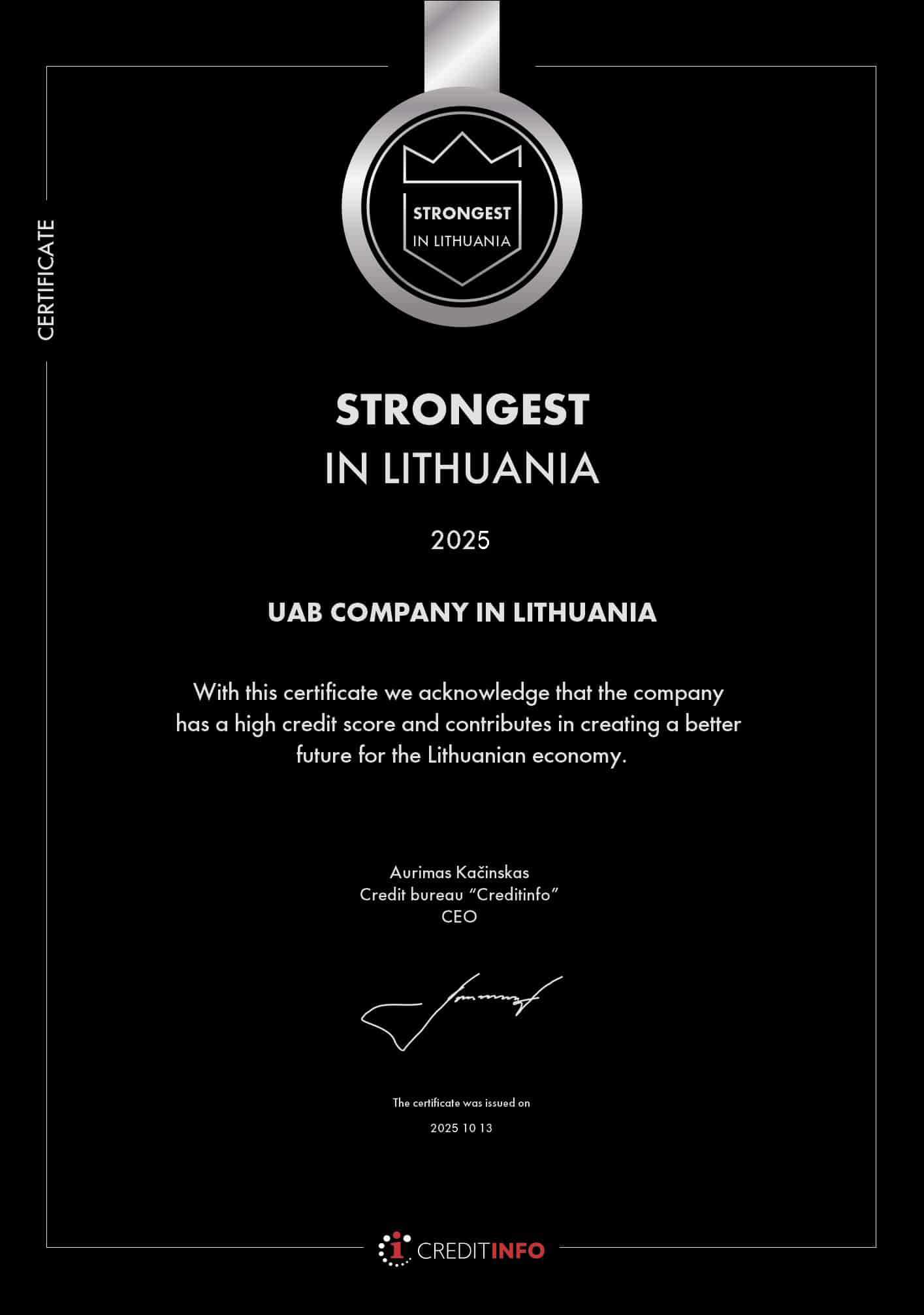
Company in Lithuania UAB has been recognised as one of Lithuania’s most trusted business services firms. Based on the independent economic data of 2025, we have been awarded the Strongest in Lithuania designation for four consecutive years — a testament to our financial stability, professional credibility, and the trust that our clients place in us.

We contribute to a transparent, well-functioning business environment in the Lithuanian Republic — and we bring that same standard of integrity to every client engagement.

Ready to start your business in Lithuania?Contact our team today for a personalized consultation. We are here to make the process simple, fast and hassle-free.Contact us
Menu
Company in Lithuania
Privacy overview

This website uses cookies so that we can provide you with the best possible user experience. Cookies are small text files stored in your browser. Strictly necessary cookies are always on; analytics and marketing cookies are used only with your consent.

More information: Cookie Policy, Privacy Policy.