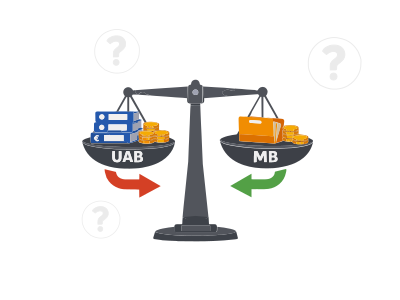
 A branch of a foreign company in Lithuania has the right to conduct commercial activities in Lithuania, to receive profits, pay taxes, receive VAT number, hire personnel, do customs operations, but at the same time it is not a separate legal entity. The activities of a Lithuanian branch of a foreign company are managed by an authorised representative appointed by the foreign company. The branch must be registered with the Lithuanian Register of Legal Entities (JAR) before commencing its registered activities. A branch is not a separate legal entity, and the foreign parent company remains liable for its obligations. By contrast, a Lithuanian subsidiary is a separate legal entity, generally established as a private limited liability company (UAB), whose obligations are legally distinct from those of its parent company, subject to applicable statutory exceptions.
A subsidiary company in Lithuania is a legal entity owned/controlled by the parent company. In this case, the structure of the company, accounting and management system takes place in accordance with the legislation of the country in which the subsidiary is registered. The duty and responsibility of officers (board members) shall be governed by the law of the State in which the subsidiary is located.
Stages of opening a branch/subsidiary of a foreign company in Lithuania
Establishing a Lithuanian subsidiary or registering a branch of a foreign company requires additional corporate documentation from the foreign parent company. This may include an official company register extract, incorporation documents, a corporate resolution and information about authorised representatives. Documents issued abroad may require translation into Lithuanian and, where applicable, an apostille or legalisation. However, documents originating from certain jurisdictions may benefit from exemptions under EU legislation or international agreements. The registration process may take several business days or several weeks, depending on the corporate structure, documentation and verification requirements. A fixed one-month registration period is not established by Lithuanian law. The foreign parent company must appoint an authorised representative to manage its Lithuanian branch and act within the scope of the powers granted. Appointment as a branch manager does not automatically require an employment contract with a separate Lithuanian company, as the branch itself is not an independent legal entity. The representative’s employment or service relationship must be structured in accordance with the applicable Lithuanian employment, immigration, tax and social security requirements.
If the founder is a foreign legal entity, the following information must be submitted to the Lithuanian State Register:
- Registration certificate of the founder, the charter of the parent company.
- Data of the founder (company name, registration code, address, director or management bodies: first name, surname, personal code, address declaring residence of the representative).
- Data of the director of the company (name, surname, identity code, address of residence).
- The name of the branch/subsidiary.
- Exact address of the branch (requires consent of the owner to provide premises to the branch).
- If the registered office premises are owned by a natural person, the owner’s consent to use the address must be provided in the form required by the Lithuanian Centre of Registers. Notarial certification may be necessary for paper-based registration procedures, while electronic consent may be accepted where the owner can authenticate and sign it through the Centre of Registers’ electronic system. Notarial certification is not mandatory in every case.
- If the registered office premises are owned by a legal entity, consent must be provided by a person authorised to represent the property owner. The consent must satisfy the applicable signature and registration requirements. A corporate seal is not generally mandatory for Lithuanian companies unless its use is specifically required by law or the company’s governing documents.
- Information on the activities of the branch.
- In addition, you need to provide:
- Statement certifying that the founder is registered in a foreign state in the registration centre of legal entities.
- Annual financial report of the parent company (in case of establishment of a branch).
- A decision of the competent governing body of the foreign parent company authorising the establishment of a Lithuanian branch. The decision must comply with the parent company’s governing law and corporate documents. Notarial certification is not automatically required for every such decision, although document authentication, translation, apostille or legalisation may be necessary depending on the country of origin and applicable registration requirements.
The submission of documents to the Lithuanian State Authorities and their certification to a notary may be carried out by a power of attorney.
COST OF ESTABLISHMENT OF A SUBSIDIARY/SUBSIDIARY IN LITHUANIA
| Service | Price |
|---|---|
| Establishment of the company, payment of the authorised capital, payment of the state fee | 1,000 EUR |
| Representation of the party to the transaction by proxy (for one person) | 790 EUR |
| Notary services, state fee for re-registration of the company | 200 EUR |
Translation of documents of the parent company of the Lithuanian company is paid separately.
Branch/subsidiary taxation
A foreign company may become subject to Lithuanian Corporate Income Tax when it carries out business through a permanent establishment in Lithuania or receives certain other categories of Lithuanian-source income subject to taxation. A registered Lithuanian branch will generally constitute a permanent establishment for tax purposes where the relevant statutory or treaty conditions are satisfied. However, a permanent establishment may also arise without registering a formal branch. The existence of a taxable permanent establishment depends on the nature, duration and circumstances of the business activities and the applicable double taxation agreement.
Taxation of a foreign affiliate
A Lithuanian permanent establishment of a foreign company is generally subject to Corporate Income Tax on profits attributable to its activities in Lithuania, calculated in accordance with Lithuanian tax legislation and any applicable double taxation agreement. The taxable profit is determined by reference to the functions performed, assets used, risks assumed and applicable expense allocation rules, rather than solely by the geographical source of revenue. Relief from double taxation may be available in the foreign parent company’s country of tax residence through a foreign tax credit or exemption mechanism, depending on domestic legislation and the applicable tax treaty. Such relief is not automatically guaranteed.
The tax paid by the Lithuanian branch is a tax on profits received in the territory of Lithuania.
From 1 January 2026, the standard Corporate Income Tax rate in Lithuania is 17%. A reduced rate of 7% may apply to qualifying small companies and other eligible entities with annual revenue not exceeding EUR 300,000, subject to statutory conditions and related-party restrictions. Eligible newly established companies may qualify for a 0% rate during their first two tax periods. Lithuanian permanent establishments of foreign companies are generally subject to the standard 17% rate unless a specific statutory relief applies.
From 1 January 2026, dividends paid by a Lithuanian company to a foreign corporate shareholder are generally subject to 17% Lithuanian withholding tax, unless an exemption or reduced rate applies under Lithuanian legislation or an applicable double taxation agreement. The participation exemption may apply where the corporate shareholder holds at least 10% of the voting shares for a continuous period of at least 12 months, subject to applicable conditions and anti-abuse provisions. Dividends paid to individual shareholders are generally subject to 15% Personal Income Tax. Transfers of profits from a Lithuanian branch to its foreign head office are not ordinarily treated as dividend distributions because the branch and head office form part of the same legal entity.
The standard VAT rate in Lithuania is 21%, while reduced rates and exemptions apply to certain goods and services. Supplies of goods exported outside the EU may qualify for the 0% VAT rate where the applicable conditions and documentary requirements are satisfied. Input VAT may be deductible or refundable where permitted by Lithuanian VAT legislation. VAT-registered businesses must submit VAT returns according to their applicable reporting period, which may be monthly or otherwise determined under statutory rules. Not all businesses are required to submit VAT returns every month, and VAT refunds are not automatically available for every export transaction.
Lithuanian employment-related social security contributions are generally calculated on the employee’s gross salary. In 2026, employees ordinarily pay 19.5% in social security and compulsory health insurance contributions, with an additional 3% contribution for participants in the supplementary second-pillar pension accumulation system. Employer contributions generally range from approximately 1.77% to 3.03% for indefinite-term employment contracts, depending on the occupational accident risk category. Different rates may apply to fixed-term contracts and certain categories of employment. Personal Income Tax is calculated separately under the applicable progressive tax rules.
Agreement on avoidance of double taxation
If, on the basis of the provisions of the Double Taxation Agreement between a foreign company and Lithuania, it is considered that a foreign organization carries out its activities in Lithuania through a permanent establishment, but all or part of the profit of a foreign entity through this permanent institution is exempt from liability, such a permanent institution must maintain accounts, make declarations and reports and pay taxes. The obligations of the franchise, like any other permanent establishment, do not pay income tax per se or pay only for that part of the profit which may be taxed in Lithuania in accordance with the provisions of the agreement on avoidance of double taxation.
Accounting and audit of a subsidiary/subsidiary in Lithuania
The Mission is required to maintain accounting records and to report in accordance with the laws of the country in which it operates.
A Lithuanian branch of a foreign company must comply with the applicable accounting and financial disclosure requirements. Under the Lithuanian Law on Companies, branches of foreign companies are generally required to submit the foreign parent company’s annual financial statements prepared, audited and disclosed in accordance with the law of its jurisdiction of incorporation. Where the parent company’s financial statements are prepared under accounting requirements that are not considered equivalent to the relevant EU requirements, the Lithuanian branch may be required to prepare and submit separate financial statements in accordance with Lithuanian legislation. The applicable obligations depend on the foreign company’s jurisdiction and the relevant statutory provisions.
Audit of branch in Lithuania
The audit and financial disclosure obligations of a Lithuanian branch depend on the legal status of its foreign parent company, the applicable accounting framework and statutory audit requirements. Where the foreign parent’s annual financial statements are subject to a mandatory audit, the relevant audit report may need to be submitted together with the financial statements. A Lithuanian branch may also be required to prepare separate financial statements or comply with additional audit obligations in circumstances established by law. It is therefore incorrect to state that branches are universally exempt from audit reporting requirements.
Employment in a branch of a foreign company in Lithuania
For employment in Lithuania of third-country citizens, it is necessary to obtain documents granting a citizen of a foreign state the right to work and reside in Lithuania.
A non-EU national transferring from a foreign parent company to a Lithuanian branch or another eligible group entity may qualify for a temporary residence permit as an intra-corporate transferee (ICT), provided that the applicable requirements under the Lithuanian Law on the Legal Status of Foreigners are satisfied. These include prior employment within the corporate group, an eligible managerial, specialist or trainee position, and appropriate qualifications or professional experience. The required period of prior employment and supporting documents depend on the relevant ICT category. Appointment as an authorised branch representative does not automatically establish eligibility for an ICT residence permit.
Within one company, you can be transferred as a manager and get a temporary residence permit. In this case, temporary residence will be granted for a period of time for which you will be transferred to work in the host company established in the Republic of Lithuania, but not for more than 3 (three) years.
An intra-corporate transferee must satisfy the applicable requirements concerning prior employment within the foreign undertaking or corporate group and demonstrate a genuine temporary assignment to the Lithuanian host entity. The employment relationship, transfer documentation, remuneration and professional qualifications must meet the statutory conditions. The applicable legislation does not establish a universal requirement that every qualifying employment contract must be permanent or indefinite in duration.
If you already have a valid temporary residence permit as a person who is transferred to another job in one company issued by another EU Member State and you intend to arrive at the host company established in the Republic of Lithuania, For more than 90 (ninety) days during the 180-day period, you can also get a temporary residence permit.
In this case, you are relieved of the obligation to obtain a work permit in the Republic of Lithuania.
Contact Company in Lithuania UAB for detailed information on the steps to be taken to establish a branch/subsidiary of your company in Lithuania.