5 pagrindiniai veiksniai
- The Lithuanian tax system includes corporate income tax (standard rate — 16%), value added tax (standard rate — 21%), payroll taxes and social insurance contributions, and personal income tax. Each of these taxes has its own calculation rules, payment deadlines, and reporting requirements that a foreign business owner must comply with from the moment the company is registered.
- Non-residents of Lithuania are subject to taxation on income derived from Lithuanian sources. This means that profits of a Lithuanian company, dividend payments, director’s salary, and other payments from Lithuania may be taxed in Lithuania — regardless of where the owner or income recipient resides.
- Dividend distributions from a Lithuanian company are subject to withholding tax. The standard rate is 15%, but it may be reduced or eliminated under double tax treaties or EU directives. The profit withdrawal structure requires planning at the company formation stage.
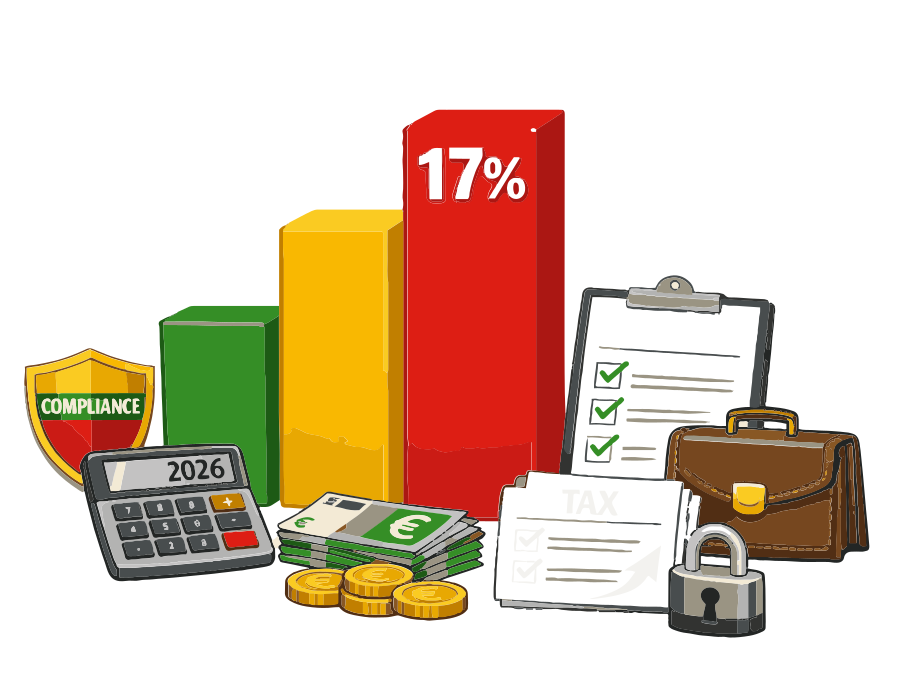
- Lithuania introduced further Corporate Income Tax changes effective from 1 January 2026. The standard Corporate Income Tax rate increased from 16% in 2025 to 17% in 2026, while the reduced rate for qualifying small companies increased from 6% to 7%. Eligible newly established small companies may apply a 0% rate during their first two tax periods, subject to statutory conditions. Foreign entrepreneurs should distinguish between the tax rules applicable to the 2025 tax period and those applicable from 2026 onwards.
- Company in Lithuania UAB (company code 304377400) provides company registration, accounting support, tax reporting, and licence assistance services for non-residents of Lithuania. Our team helps foreign entrepreneurs establish tax compliance from the first day of the company’s operations.
Taxes in Lithuania are one of the first topics that a foreign entrepreneur examines when considering Lithuania as a jurisdiction for doing business. Lithuania offers competitive tax rates compared to many Western European countries, transparent legislation, and a well-developed digital infrastructure for filing declarations and reports. However, for a non-resident unfamiliar with the Lithuanian tax system, without a structured understanding of all obligations there is a significant risk of making errors that lead to penalties and additional costs.
This guide provides a practical overview of all the main taxes applicable to foreign company owners in Lithuania in 2025 — from corporate income tax and VAT to payroll taxes, dividends, and cross-border payments.
What Taxes Apply in Lithuania in 2025? Complete Overview for Foreigners
Main Business Taxes: CIT, VAT, Payroll
A company registered in Lithuania faces three main categories of taxes. Corporate Income Tax (CIT) is levied on company profits. Value Added Tax (VAT) applies to the sale of goods and provision of services. Payroll taxes include social insurance contributions (Sodra) and personal income tax on employees, which the employer is required to calculate, withhold, and remit to the relevant authorities.
Taxes for Individuals and Shareholders
Owners of Lithuanian companies who are individuals bear tax obligations when receiving income from their company. This applies to dividend payments, salary (if the owner serves as director or employee), and other distributions. The rates and taxation procedure depend on the type of income and the tax residency of the recipient.
When Foreigners Become Taxable in Lithuania
Lithuanian companies are separate taxpayers and are generally subject to Corporate Income Tax on their taxable profits, regardless of the tax residence of their shareholders. Non-resident individuals may be subject to Lithuanian Personal Income Tax on specified Lithuanian-source income, including dividends, remuneration for employment performed in Lithuania and income from Lithuanian real estate, subject to applicable statutory exemptions and double taxation agreements. Merely owning shares in a Lithuanian company does not automatically make the foreign shareholder personally liable for Lithuanian tax on the company’s undistributed profits. Company registration also creates corporate accounting and reporting obligations, even where the company has no taxable income.
Corporate Income Tax in Lithuania: How Company Profits Are Taxed
CIT Rates in 2025: Standard vs Reduced
The standard corporate income tax rate in Lithuania is 16%. For small companies meeting certain criteria, a reduced rate of 6% is available. For the 2025 tax period, the reduced Corporate Income Tax rate of 6% applied to qualifying small companies, subject to the applicable revenue, employee-number, ownership and related-party requirements. Eligible newly established small companies could instead apply a 0% Corporate Income Tax rate during their first tax period, provided that the statutory conditions were satisfied. From 2026, the reduced rate increased to 7%, while the 0% incentive was extended to the first two tax periods for qualifying newly established companies.
Who Qualifies for the Reduced Tax Rate
The reduced rate of 6% is available to companies with an average number of employees not exceeding 10 during the tax period and income not exceeding EUR 300,000 for the tax period. For non-residents registering a company in Lithuania, this can be a significant advantage at the initial stage, although additional conditions restricting the application of the reduced rate must also be taken into account.
What Is Considered Taxable Profit
The taxable profit of a Lithuanian company is calculated as the difference between income and deductible expenses, subject to adjustments provided for by law. Not all accounting expenses are automatically recognised as deductible for tax purposes. Entertainment expenses, fines, certain types of provisions, and expenses unrelated to the company’s activities may be limited or excluded from deduction.
When and How CIT Is Paid
Corporate income tax is paid annually based on the results of the tax period. The company is required to file an annual corporate income tax return and pay the tax within the established deadlines. Depending on the size of the company, advance CIT payments during the year may apply. Compliance with deadlines and correct completion of declarations is a mandatory condition of tax compliance.
VAT in Lithuania: Rules for Local and Cross-Border Business
VAT Rates and Taxable Transactions
The standard VAT rate in Lithuania is 21%. Reduced rates of 9% and 5% apply to certain categories of goods and services, such as books, periodicals, heating, and certain food products. VAT is charged on the supply of goods and provision of services within Lithuania, the import of goods, and intra-Community acquisitions.
When VAT Registration Is Mandatory
From 1 May 2025, Lithuania changed the calculation of its domestic VAT registration threshold. Businesses generally become liable for VAT registration when the value of taxable supplies carried out in Lithuania exceeds EUR 45,000 during the preceding or current calendar year, rather than during a rolling 12-month period. VAT obligations may also arise when qualifying intra-EU acquisitions exceed EUR 14,000 or where businesses receive or provide certain cross-border services. Non-established foreign businesses may be required to register from their first taxable transaction, depending on the place-of-supply rules, reverse-charge provisions and applicable exemptions.
EU Transactions and Reverse Charge
Special rules apply to the supply of goods and services between companies in different EU countries. Intra-Community supplies of goods between registered VAT payers may be taxed at 0% provided certain conditions are met. The reverse charge mechanism means that the obligation to pay VAT shifts to the buyer. Correct application of these rules requires precise documentation and reporting.
Applying 0% VAT for Exports
The export of goods outside the EU is subject to VAT at 0%. However, to apply the zero rate, the company must have documentary evidence of the actual export of goods from the EU territory. Errors in export documentation may result in the tax authorities refusing to apply the zero rate and assessing VAT at the standard rate.
Payroll Taxes in Lithuania: Real Cost of Hiring Employees
Minimum Salary and Cost Structure
From 1 January 2025, the minimum monthly wage in Lithuania is EUR 1,038 and the minimum hourly wage is EUR 6.35. The total cost of an employee for the employer includes not only the gross salary but also social insurance contributions, personal income tax, and related obligations for calculation and remittance to the budget.
Employer Taxes and Contributions
In 2025, employees in Lithuania generally paid mandatory social security and health insurance contributions of 19.5% of their gross salary, with an additional 3% contribution for employees participating in supplementary second-pillar pension accumulation. Employers were responsible for withholding and remitting employee contributions and paying separate employer social security and related contributions, generally starting at approximately 1.77% of gross salary for indefinite-term employment contracts, depending on the occupational accident risk category and other applicable conditions. Employers should distinguish between employee deductions and additional employer costs when calculating total employment expenses.
Social Security System (Sodra)
Sodra is the State Social Insurance Fund Board of Lithuania. The employer must register with Sodra before hiring the first employee and ensure that each worker is properly enrolled in the social insurance system. Social insurance contributions cover pensions, health insurance, unemployment insurance, and other social benefits.
Payroll Reporting Obligations
The employer is required to submit regular reports to Sodra and the tax inspectorate. Reporting includes monthly data on accrued salaries, withheld taxes, and remitted contributions. Failure to meet reporting deadlines or incorrect completion of forms results in penalties.
Personal Income Tax for Non-Residents in Lithuania
What Income Is Taxed in Lithuania
Non-residents of Lithuania pay personal income tax on income derived from Lithuanian sources. Such income includes salary for work performed in Lithuania, dividends from Lithuanian companies, income from the rental of real estate in Lithuania, board member remuneration, and other payments provided for by law.
PIT Rates and Taxation Logic
Personal income tax in Lithuania applies on a progressive scale. The standard rate is 20% for income not exceeding the established threshold and 32% for income above that threshold. Dividends are taxed at a separate rate of 15%. The application of a specific rate depends on the type of income and the status of the recipient.
Tax Residency vs Non-Residency
Tax residency determines the scope of an individual’s tax obligations in Lithuania. A resident is required to declare and pay tax on worldwide income. A non-resident is taxed only on income from Lithuanian sources. Residency status is determined based on a combination of criteria, including the place of permanent residence and the time spent in the country (183 days or more during the tax period).
Double Tax Treaties: How to Reduce Taxes
Lithuania has concluded double tax treaties with more than 50 countries. These treaties allow for the reduction or elimination of double taxation of the same income in two jurisdictions. To apply reduced treaty rates, a certificate of tax residency from the competent authority of the relevant country must be provided, and the established procedure must be followed.
Dividends and Profit Withdrawal from a Lithuanian Company
Dividend Taxation for Foreign Owners
When dividends are paid from a Lithuanian company to an individual who is a non-resident of Lithuania, withholding tax applies. The standard rate is 15%. If dividends are paid to a legal entity that is an EU resident, the tax may be reduced to 0% under the conditions of the EU Parent-Subsidiary Directive.
Withholding Tax on Distributions
The Lithuanian company is required to withhold and remit withholding tax to the budget when paying dividends. The responsibility for correct calculation and timely remittance of the withheld tax rests with the company making the distribution. Errors in withholding may lead to additional assessments and penalties.
Structuring Profit Distribution Efficiently
Planning the procedure for profit distribution is an important part of tax strategy. The choice between paying dividends, director’s salary, or other forms of withdrawing funds from the company depends on the specific situation of the owner, their tax residency, and applicable treaties. Proper structuring at the company formation stage makes it possible to optimise the overall tax burden.
Withholding Tax in Lithuania: Cross-Border Payments Explained
Payments Subject to WHT
Lithuanian withholding tax applies to specified categories of Lithuanian-source income paid to non-residents. The applicable treatment depends on whether the recipient is an individual or a foreign legal entity, the nature of the payment, the place where services are performed, and any relevant tax treaty or statutory exemption. Dividends, certain interest and royalty payments, and other specifically defined income may be subject to withholding tax. Ordinary management and consulting fees paid to foreign companies are not automatically subject to Lithuanian withholding tax merely because the payer is a Lithuanian company. Such payments must be assessed under the Lithuanian Law on Corporate Income Tax and any applicable double taxation agreement.
Standard Rates and Reductions
Lithuanian withholding tax rates depend on the type of income and the legal status of the recipient. For the 2025 tax period, dividends paid to foreign corporate shareholders were generally subject to 16% withholding tax, unless a participation exemption or applicable treaty relief applied. Dividends paid to non-resident individuals were generally subject to 15% Personal Income Tax. Certain interest and royalty payments to foreign entities were generally subject to 10% withholding tax, subject to statutory exemptions, EU directives and applicable double taxation agreements. From 2026, the standard tax rate on taxable dividends paid to foreign corporate shareholders increased to 17%.
Treaty Application Requirements
To apply reduced withholding tax rates or exemptions under a double taxation agreement, the Lithuanian payer must comply with the applicable documentation and procedural requirements established by the State Tax Inspectorate (VMI). This generally includes obtaining the appropriate DAS-1 form or other documentation accepted under the relevant procedure to establish the recipient’s tax residence and entitlement to treaty benefits. Where treaty relief is not applied at the time of payment, the recipient may be entitled to request a refund of excess Lithuanian withholding tax through the applicable DAS-2 procedure. Treaty benefits are also subject to beneficial ownership requirements and relevant anti-abuse provisions.
Real Estate and Other Business Taxes in Lithuania
Real Estate Tax for Companies
Companies owning real estate in Lithuania pay real estate tax. The rate is set by municipalities and ranges from 0.5% to 3% of the tax value of the property. The specific rate depends on the location and type of property.
Land Tax and Local Rules
Lithuanian Land Tax generally applies to privately owned land, with municipal tax rates ranging from 0.01% to 4% of the taxable land value. The tax is generally payable by the landowner, subject to statutory exemptions and special provisions. Persons or companies leasing state-owned land may instead be liable for state land lease payments under separate rules. Foreign companies owning land in Lithuania are subject to the applicable land taxation requirements, while ownership eligibility may also depend on Lithuanian constitutional and statutory restrictions.
Other Relevant Taxes
Depending on the type of activity, excise duties, environmental pollution taxes, state fees, and other mandatory payments may apply. The applicability of these taxes is determined by the specifics of the business and should be assessed during the planning stage.
Tax Compliance in Lithuania: Reporting and Obligations
Corporate Tax Reporting
A Lithuanian company is required to maintain accounting records in accordance with Lithuanian standards, file annual financial statements, and submit a corporate income tax return. Filing deadlines are established by law, and failure to meet them results in sanctions.
VAT and Transaction Reporting
Lithuanian VAT-registered businesses must submit VAT returns according to the reporting period established under Lithuanian VAT legislation. A monthly reporting period generally applies to legal entities, although quarterly or other reporting periods may be available where statutory conditions are satisfied. EC Sales Lists must be submitted for qualifying intra-Community supplies and certain cross-border services. Intrastat declarations are required only where the value of relevant intra-EU movements of goods exceeds the applicable statistical reporting thresholds. Intrastat reporting does not automatically apply to every VAT-registered company conducting transactions within the EU.
Payroll and Social Reporting
Employers submit monthly reports to Sodra and the tax inspectorate containing data on accrued salaries, withheld taxes, and remitted contributions. An annual summary report is filed for each employee.
Record-Keeping Requirements
Lithuanian law requires the retention of accounting documents for at least 10 years. All primary documents — invoices, contracts, payment records — must be properly prepared and available for inspection by the tax authorities.
Tax Risks in Lithuania for Foreign-Owned Companies
VAT Errors in Cross-Border Transactions
One of the most common errors is the incorrect application of VAT rules in intra-EU transactions. Incorrect determination of the place of supply, errors in applying the zero rate, or incorrect use of the reverse charge mechanism can lead to additional VAT assessments, interest, and penalties.
Incorrect Profit Distribution
Paying dividends without proper documentation, errors in withholding tax at source, or using a suboptimal structure for withdrawing funds are common problems for companies with foreign owners. Every payment from the company must have a legal basis and be properly documented.
Lack of Substance
Lithuanian tax authorities and EU bodies are increasingly scrutinising whether a company has genuine economic substance in its country of registration. A company without employees, a real office, assets, or genuine business activity in Lithuania may be classified as a “shell structure”, which carries tax consequences including the refusal to apply preferential rates and treaty benefits.
Penalties and Tax Audits
Lithuanian tax authorities conduct both scheduled and unscheduled audits. Penalties for violations range from administrative fines to substantial financial sanctions. For foreign owners, the cost of correcting errors almost always exceeds the cost of properly organised compliance from the outset.
Tax Changes in Lithuania: What Will Change After 2025
Corporate Tax Increase in 2026
From 1 January 2026, Lithuania increased the standard Corporate Income Tax rate from 16% to 17% and the reduced rate for qualifying small companies from 6% to 7%. The preferential 0% rate for qualifying newly established small companies was extended from the first tax period to the first two tax periods, subject to statutory conditions. These changes are already in force and should be reflected in financial projections, business plans and tax compliance arrangements for 2026 and subsequent tax periods.
Changes in Personal Taxation
Lithuania introduced significant Personal Income Tax changes effective from 1 January 2026. Employment income and other income subject to the general progressive taxation regime are taxed at rates of 20%, 25% and 32%, depending on the applicable annual income thresholds. Certain categories of income, including dividends and qualifying investment income, remain subject to separate rules. Foreign entrepreneurs and non-resident individuals should assess how the revised tax rates interact with Lithuanian-source income, applicable withholding obligations and double taxation agreements.
Planning Ahead for Foreign Entrepreneurs
When deciding to register a company in Lithuania, it is necessary to consider not only the current tax environment but also announced changes. Proper planning makes it possible to adapt the business structure to new conditions before they take effect.
Why Non-Residents Need Accounting Support in Lithuania
Complexity of the Lithuanian Tax System
The Lithuanian tax system includes numerous taxes, rates, exemptions, and special rules. For a non-resident who does not speak Lithuanian and is unfamiliar with local practice, independently managing tax accounting and reporting carries a high risk of errors.
Risk of Non-Compliance Without Local Support
The absence of professional accounting support in Lithuania is one of the main reasons for tax violations among foreign companies. Missed deadlines, incorrect declarations, and incorrect application of rates can lead to penalties and reputational damage.
Scope of Professional Services
Company in Lithuania UAB provides comprehensive support for foreign entrepreneurs: company registration in Lithuania, tax registration, bookkeeping, payroll administration, preparation and filing of tax returns, advice on structuring payments, and assistance during tax audits. Contact Company in Lithuania UAB for a free initial consultation.
Dažnai užduodami klausimai
The main tax for a Lithuanian company is Corporate Income Tax (CIT) at a standard rate of 16%. Small companies with income up to EUR 300,000 and no more than 10 employees may apply a reduced rate of 6%. In addition to CIT, the company is required to pay VAT (21%), payroll taxes, and social insurance contributions.
Yes, a non-resident is required to pay taxes in Lithuania on income from Lithuanian sources. This includes dividends from a Lithuanian company, salary for work in Lithuania, income from Lithuanian real estate, and other payments. The scope of tax obligations depends on the type of income and the existence of a double tax treaty.
The standard withholding tax rate on dividends paid to a non-resident individual is 15%. The rate may be reduced under double tax treaties. When dividends are paid to a legal entity that is an EU resident, an exemption under the EU Parent-Subsidiary Directive may apply.
VAT registration is mandatory when annual turnover from taxable transactions exceeds EUR 45,000. For non-residents, registration may be required from the first transaction — when supplying goods within Lithuania or providing certain services in the country.
Lithuania’s 2026 tax amendments are already in force. The standard Corporate Income Tax rate increased to 17%, while the reduced rate for qualifying small companies increased to 7%. Eligible newly established companies may benefit from a 0% rate during their first two tax periods. Personal Income Tax rules were also revised, including the introduction of a 25% intermediate progressive rate for income within the applicable thresholds. These changes should be considered when establishing a Lithuanian company, planning remuneration and dividends, and assessing cross-border tax obligations.
Išvada
The Lithuanian tax system offers competitive conditions for doing business but requires precise compliance with rules, deadlines, and procedures. For a foreign entrepreneur, understanding the tax structure — corporate income tax, VAT, payroll taxes, personal income tax, and withholding tax — is a mandatory condition for the successful operation of a company in Lithuania.
Errors in tax compliance cost significantly more than professional support from day one. Plan your business structure taking into account current rules and upcoming changes, ensure proper accounting and reporting, and engage professional support to manage your tax obligations.
If you are planning to register a company in Lithuania or are already running a business through a Lithuanian company, contact Company in Lithuania UAB for a free initial consultation.
Company in Lithuania UAB (company code 304377400) is a Lithuania-registered company providing services for company incorporation, accounting support, and assistance with obtaining licences for non-residents of Lithuania. This article is for informational purposes only and does not constitute legal or tax advice.