

 The tax legislation in Lithuania is favourable for international business and the tax system is adapted to the legislation of the European Union.
It is very important before starting business in another jurisdiction, to get acquainted with the tax system and the local rules, to avoid any inconvenience in the future.
By opening a company in Lithuania, we will be happy to provide you with an individual consultation regarding taxes and rules regarding doing business in Lithuania.
Also, you will be able to get brief information regarding the tax systems below.
Lithuania has eight types of taxes:
Direct taxes
- Pelno mokestis
- Income tax on the population
- Property tax
- Land tax
- Inheritance and donation tax
Indirect taxes
- Value added tax
- Excises
- Lottery and gambling tax
Other taxes and contributions to the State budget:
- Social insurance contributions
- A tax on public natural resources
- A tax on oil and natural gas
- A tax on environmental pollution
- Consular fees
- Stamp duty
- Sales tax
Mokesčiai Lietuvoje
Privalumai
 Lithuanian Corporate Income Tax from 0% for eligible newly established companies during their first two tax periods, 7% for qualifying small companies, and 17% at the standard rate in 2026.
 Opportunity to obtain tax exemptions and availability of free economic zone
 Entrepreneurship incentive: possibility to defer income tax
 Taxable income can be reduced by the amount of expenses
Corporate income taxes

From 1 January 2026, the standard Lithuanian Corporate Income Tax (CIT) rate is 17% of taxable profits. Qualifying companies with annual revenue not exceeding EUR 300,000 may apply a reduced 7% rate, subject to statutory conditions and restrictions concerning related entities. Eligible newly established companies may apply a 0% rate during their first two tax periods. The previous general limit of 10 employees no longer applies to the reduced-rate regime from 2026. Corporate Income Tax is calculated on taxable profits, not on total sales revenue.
There is a standard CPN rate of 15%. The CPN rate can be reduced to 0% or 5% for small businesses and agricultural businesses, however. The 20% CPN rate applies to credit institutions’ taxable profits exceeding 2 million euros for the period beginning on 1 January 2020 and ending in 2025. Calculating taxable profits is subject to special rules.
Lithuanian tax residents are generally subject to the CPN on their local and international taxable income. In calculating taxable income, deductible expenditures and non-taxable income are subtracted from the total income for a tax period.
In Lithuania, resident tax companies are not taxed on their income if their income is derived from activities conducted through permanent establishments (PEs) in foreign countries that are part of the European Economic Area or have double taxation agreements (DTTs) with Lithuania.
Further, if a foreign country has a DTT with Lithuania and income from foreign sources not derived through CP is taxed at source (WHT) in that country, the CPN may be reduced or even not applied.
In Lithuania, income received by non-resident companies is taxed through their local permanent establishments and reduced by deductible expenses.
Non-profit organizations that profit from the activities of businesses must pay corporate income tax as well.
For small businesses, CPN rates have been reduced
From the 2026 tax period, eligible newly established Lithuanian companies may qualify for a 0% Corporate Income Tax rate during their first two tax periods. Qualifying companies with annual revenue not exceeding EUR 300,000 may subsequently apply the reduced 7% rate, subject to statutory conditions. The standard rate is 17%. Eligibility for preferential treatment depends on the company’s ownership structure, related-party restrictions and other applicable legal requirements.
Dividend tax
- Dividends paid to non-resident individuals are generally subject to 15% Lithuanian Personal Income Tax, subject to applicable double taxation treaty relief.
- Dividends paid to foreign corporate shareholders are generally subject to 17% Lithuanian Corporate Income Tax withholding in 2026, unless a statutory participation exemption or applicable double taxation treaty provides relief.
- A 0% withholding tax rate does not automatically apply merely because the recipient resides in the EU or in a country that has a double taxation treaty with Lithuania. Eligibility depends on the recipient’s legal status and the relevant exemption or treaty conditions.
- Over 55 double taxation agreements have been concluded with Lithuania, including with EU countries, India, Georgia, and Ukraine.
A physical person is subject to a 15% dividend tax. Exceptionally, 0% applies to recipients of funds residing in the EU or member states of tax conventions. Over 55 double taxation agreements have been concluded by Lithuania, including those with EU countries, India, Georgia, and Ukraine.
Residents paying dividends to residents are subject to 15 percent corporate tax, unless the parent company owns at least 10 percent of the shares of the subsidiary for at least 12 months, then dividends are tax-free. An EEA member state’s corporate income tax or equivalent is also not applicable to dividends received by foreign legal entities registered in the state.
Income tax on the population
From 1 January 2026, Lithuania’s statutory minimum monthly wage is EUR 1,153 gross. The monthly non-taxable income allowance (NPD) depends on the employee’s income and applicable statutory conditions and is not a universal fixed EUR 300 amount. Employment income under the general progressive Personal Income Tax regime is subject to rates of 20%, 25% and 32%, depending on the applicable annual income thresholds. Payroll tax calculations must also take into account employee social insurance contributions, compulsory health insurance and any applicable pension accumulation contributions. The outdated examples based on a EUR 555 minimum wage should be replaced with calculations using the rates and allowances applicable to 2026.
- Salary 555 euros
- EUR 555 Wage – EUR 555 Minimum Wage = EUR 0
- 0.15*EUR0=EUR0
- EUR 300 standard non-chargeable amount – EUR 0 = EUR 300 of non-chargeable income
- Salary 1,000 euros
- EUR 1000 Wage – EUR 555 Minimum Wage = EUR 445
- 0.15 * 445 EURO = 66.75 EURO
- Standard EUR 300 – EUR 66.75 = EUR 233.25 of unencumbered income
Property tax
From 1 January 2026, Lithuania applies revised real estate taxation rules. For an individual’s principal residence, the taxable value is generally exempt up to at least EUR 450,000, with the municipality permitted to establish a higher exemption threshold. The portion exceeding the applicable threshold is subject to municipal rates ranging from 0.1% to 1%. Other qualifying residential and specified non-commercial properties owned by individuals are subject to progressive tax rates ranging from 0% to 1%, depending on their aggregate taxable value. Different rules and rates apply to commercial property and property owned by legal entities.
Land tax
Tax payments on land constitute the land tax in Lithuania, and the provisions on how this tax is calculated and paid are determined by the local councils. Land taxes are imposed on privately owned land, and the rate ranges from 0.01 to 4 percent of the land’s value (forests are not subject to the land tax).
In the first half of the year, landowners who acquire land are required to pay a full-year tax. Taxes must be paid from the following year if the land is acquired during the second half of the year. It is not necessary to pay the tax if the land is sold during the first half of the year, but it must be paid for the whole year if it is sold during the second half.
Excises
The following products are collected by excise, which is intended to correct the consumption of goods sold in the country:
Excise duties in Lithuania apply to specified categories of goods under the Lithuanian Law on Excise Duties, including alcoholic beverages, tobacco products, electronic cigarette liquids, certain other nicotine-related products, energy products and electricity. Coffee, chocolate, jewellery, luxury cars and publications are not subject to a general Lithuanian excise duty merely because they belong to these product categories. Other taxes or registration charges may apply to particular goods under separate legislation.
Excise is free of alcohol and its raw materials imported by State-owned enterprises licensed to produce alcohol and on exported goods.
Value added tax (VAT)
Rate 21 per cent
VAT registration obligations in Lithuania depend on the nature and value of the company’s transactions. Since 1 May 2025, the domestic VAT registration threshold of EUR 45,000 is assessed using qualifying turnover in the current or preceding calendar year, rather than a rolling 12-month period. Intra-Community acquisitions of goods may trigger VAT obligations when the applicable EUR 14,000 threshold is exceeded. VAT registration or other VAT compliance obligations may also arise below these thresholds for certain cross-border services and other transactions. Applicable small business scheme exemptions must be assessed separately.
If the shareholder has more than 50% of shares in other companies, the criteria are summed up for all companies.
Lithuania’s standard VAT rate is 21%. From 1 January 2026, reduced rates of 12% and 5% apply to qualifying categories of goods and services.
- 12% VAT – qualifying accommodation services, scheduled passenger transport and admission to certain cultural and artistic events.
- 5% VAT – qualifying publications, medicines, medical products and other goods and services expressly covered by the applicable legislation.
- 21% VAT – the standard rate, including residential heating and hot water supplies that no longer benefit from the previous reduced rate.
Eligibility for a reduced rate depends on the exact goods or services and the relevant statutory conditions.
Lithuania has a standard VAT rate of 21% with a reduced rate of 9% and 5%. A VAT of 9 per cent applies to books, information publications, periodicals, accommodation and passenger transport on regular routes, while a reduced rate of 5 per cent applies to equipment for disabled persons, Persons entitled to compensation under the Health Insurance Act. Since 1 May 2025, the EUR 45,000 Lithuanian domestic VAT registration threshold is calculated by reference to qualifying turnover in the current and preceding calendar years. VAT obligations may also arise below this threshold in connection with qualifying cross-border transactions. Businesses must assess their registration and reporting obligations under the current Lithuanian Law on VAT, including any applicable small business scheme provisions.
Registration of VAT payer in Lithuania
The obligation to be registered is imposed when the turnover of a company in a financial year exceeds 45,000 euros; the procedure can be done in person at the local tax authorities or online by filling in the necessary forms – in this case, form FR 0388.
Social tax
In 2026, standard employee social insurance contributions in Lithuania generally amount to 19.5% of gross employment income, including compulsory health insurance contributions. An additional 3% pension accumulation contribution may apply where the employee participates in the relevant pension scheme. For a standard indefinite-term employment contract, employer-side contributions generally start at 1.77% of gross salary, subject to the employer’s occupational risk category and other statutory conditions. Personal Income Tax is calculated separately under the applicable progressive rates.
Taxation of representatives
Lithuanian legislation regulates representative offices and any other organizations registered in the country.
Legal entities have representations, which are subdivisions with their own registered offices and are entitled to perform the following operations. When a legal person is represented, a legal person’s interests are protected, contracts are concluded and other transactions are conducted on their behalf, and imports and exports are conducted exclusively by foreign legal entities and other entities with subsidiaries, institutions or organizations, or other subsidiary companies. There is no legal person called a legal representation.
Legal persons and organizations must inform the Register of Legal Persons upon registration of a representation if there is any change in the documents and data of a legal person, or if a legal person changes its legal status. It is the responsibility of the Administrator of the Register of Civil Law to verify the correctness of all information contained in an application for registration of foreign legal persons, to ensure that the statute is consistent with legislative requirements, and to ensure that: That foreign legal persons can be registered as representatives.
Company in Lithuania UAB listed the key issues of corporate taxation in Lithuania. For more specific tax-related questions, kontaktai for consultation with the accountant.
Company in Lithuania UAB padės jums užregistruokite savo įmonę Lietuvoje. Taip pat džiaugiamės galėdami pasiūlyti savo klientams apskaitos paslaugos and assistance in the process of VAT registration by the payer.
Company in Lithuania UAB teikia teisinę ir reguliavimo pagalbą įmonėms, siekiančioms gauti kriptovaliutų turto paslaugų teikėjų (CASP) leidimą Lietuvoje pagal Reglamentą (ES) 2023/1114 (MiCA). Nuo 2026 m. sausio 1 d. buvusi Lietuvos nacionalinė VASP registracijos tvarka nebesuteikia leidimų teikti reguliuojamas kriptovaliutų turto paslaugas. Įmonės, ketinančios teikti paslaugas, patenkančias į MiCA taikymo sritį, paprastai turi gauti CASP leidimą iš Lietuvos banko arba atitikti taikomų išimčių reikalavimus.
Taxation in Lithuania 2025
| Declaration form | Value Added Tax Declaration (VAT) of taxpayers registered as users and/or intermediaries of special DDN schemes |
| Tax period | 2024 |
| Payment code | 1001 – Declared taxes administered by GNI, and fines for administrative offences, imposed since 01.07.2015, shall be paid by a uniform payment code |
|
Value added tax is payable. The amount of VAT calculated in the annual declaration of VAT (form FR0516) is paid up to the 1st day of each month of the calendar year following the reporting calendar year. Amount of VAT payable (form FR0600) paid to the budget:
Payment Code 1001 – declared taxes administered by the State Tax Inspectorate are paid with one payment code.
In the submitted VAT account of a person not registered as a VAT payer (form FR0608), taxable and non-taxable persons not registered as VAT payers, in accordance with the provisions of articles 92 and 95 of the Law on Value Added Tax calculate and until the 25th of the next month. pays VAT on the goods and services provided, as well as goods and services purchased from foreign persons. |
|
|
Payment Code 3631 – Value Added Tax Fee for Unregistered value added taxpayers paid without filing a value added tax declaration. Until the last day of the month following the tax period, the participants of the special scheme pay VAT to a special account of the State Tax Inspectorate under the Ministry of Finance, and in the payment order must indicate a unique identifier, assigned the corresponding OSS declaration in the OSS system. Details of the special account: |
||
|
Recipient – State Tax Inspectorate under the Ministry of Finance of the Republic of Lithuania; The name of the bank is Šiaulių Bankas; BIC code of the bank – CBSBLT26; The bank account number is LT7971800000141065. |
||
| Income tax | ||
| Declaration form | Monthly Income Tax Declaration (GPM313) | |
| Tax period | 2024 | |
| Payment code |
1311 – NPFL on income of a Class A resident related to employment or related to its substance 1330 – VATFL from class B payments to residents with withholding and (or) payable income tax at the expense of a person who has paid tax credits for tax periods since 01.01.2018 1411 – Class A NPFL payments to non-residents or related relationships |
|
|
Personal income tax is paid. If the withholding person pays the income of the tax period of the relevant month related to the employment relationship or relationship, in instalments and pays the full amount of the benefit during that month, the withholding person, is obliged to pay the withheld income tax to the budget in the order of the 15th of this month, if the last part of the benefit was paid before the 15th of this month If the last part of the benefit is paid after the 15th of this month, the withholding person, must pay the withheld income tax to the budget until the last day of this month. |
||
| Value Added Tax Declaration (VAT) of taxpayers registered as users and/or intermediaries of special DDN schemes | ||
| Value added tax | ||
| Tax period | 2024 | |
| VAT reporting under the EU One Stop Shop (OSS) scheme depends on the specific scheme used. The Union and non-Union OSS schemes generally require quarterly VAT returns, submitted by the end of the month following the relevant calendar quarter. The Import One Stop Shop (IOSS) scheme requires monthly VAT returns, submitted by the end of the following month. The applicable reporting frequency and deadlines must be determined according to the scheme for which the taxpayer is registered. | ||
| Excise tax | ||
|
Declaration of Excise (FR0630) Personal Excise Declaration (FR0630A) |
||
| Excise payers are obliged to calculate excise duty on goods subject to payment to the budget (reimbursement from the budget) after the tax period, specified in Articles 10, 14, 15, 16, 50, 56, 60, 67 and 68 of this Federal Law. Excise Act. | ||
| Income tax | ||
|
Preliminary additional declaration on the income tax of the credit institution (PLN211) Preliminary Income Tax Declaration (FR0430) |
||
| The income tax has been paid. | ||
| Monthly Income Tax Declaration (GPM313) | ||
| Income tax | ||
| The Monthly Tax Declaration Form GPM313 is submitted in due course. | ||
| Declaration of Real Estate of a Natural Person (Family) (KIT715) | ||
| Property tax | ||
| KIT715 declaration form is submitted correctly. | ||
|
Declaration of Excise (FR0630) Personal Excise Declaration (FR0630A) |
||
| Excise tax | ||
| Excise payers are obliged to calculate excise duty on goods subject to payment to the budget (reimbursement from the budget) after the tax period, specified in Articles 10, 14, 15, 16, 50, 56, 60, 67 and 68 of this Federal Law. | ||
| Excise Act. This amount, in accordance with the Excise Act and the Regulations, shall be calculated in the completed FR0630 declaration form or in the FR0630A declaration form and their respective annexes. | ||
| Declaration of income (sums) paid to foreign tax subjects and their calculated income tax (FR0313) | ||
| Income tax | ||
| A properly completed FR0313 declaration form shall be submitted. | ||
| Income tax | ||
| Declaration on income tax on dividends (FR0640) Declaration on income (amounts) paid by foreign taxable entities, and the income tax on them (FR0313) | ||
| Income tax | ||
| Monthly Income Tax Declaration (GPM313) | ||
| Personal income tax is paid. | ||
| Declaration of income tax on dividends (FR0640) | ||
| Income tax | ||
| The FR0640 declaration form and its annex shall be submitted correctly. | ||
| Mandatory contributions from timber and stumpage revenues | ||
| Declaration on Mandatory Deductions from the Sale of Unprocessed Wood and Unprocessed Forest (FR0463) | ||
| Mandatory fees are payable on proceeds from the sale of unprocessed timber and unprocessed forest. | ||
| Property tax | ||
| Declaration of Real Estate of a Natural Person (Family) (KIT715) | ||
| Advance property tax is paid | ||
| Declaration on Mandatory Royalties from Unprocessed Wood and Uncovered Forest (FR0463) | ||
| Mandatory contributions from timber and stumpage revenues | ||
| A duly completed FR0463 declaration form shall be submitted. | ||
DAŽNAI UŽDUODAMI KLAUSIMAI
-
How do you define "resident of Lithuania"?The following conditions must be met for someone to be considered a resident:
- The permanent place of residence in Lithuania is the place where a natural person is registered.
- A person who spends 183 days or more in Lithuania during the tax period.
- A Lithuanian diplomat in the service is also a Lithuanian resident.
-
Taxes on e-residents in Lithuania?In Lithuania, e-Residency does not automatically entail tax residency, but only provides access to electronic services offered by the state.
-
Is dividend taxation a problem in Lithuania?Lithuania taxes dividends at 15% (exceptionally 0%). 0% applies to recipients residing in the EU or other countries with which we have tax conventions. Over 55 double taxation agreements have been concluded between Lithuania and EU countries, India, Georgia, and Ukraine as of 2021.
-
For a Lithuanian company, what are the advantages of taxation?Among the most beneficial taxes in the European Union is the taxation of Lithuanian companies. It is primarily advantageous to tax retained profits at 17% or 7%. During the reporting period, 5% is applied to companies that meet the following criteria:
- There are no more than 300,000 euros in annual sales
- Not more than 10 employees;
- The first two criteria of both companies are added if shareholders own more than 50 percent of shares in another company.
-
Can you tell me about Lithuania's direct taxes?Taxes paid directly include:
- Income tax for corporations
- Organizations and enterprises are taxed on their property
- Tax on real estate
- Taxes on individual income
- The taxation of gifts and income /ul>
-
How do Lithuanians pay indirect taxes?There are several types of indirect taxes:
- Value Added Tax
- Duties on excise
- Lotteries and gambling taxes
-
Besides taxes and contributions to the state budget, what are other types of taxes and contributions in Lithuania?The State budget is also funded by other taxes and contributions:
- Contributions to social security
- Natural resource taxes
- Natural gas and oil taxes
- Taxing pollution to reduce it
- Fees for consultations
- Taxes on stamps
- In addition to sales tax
-
How does Lithuania tax its employees' payrolls?Lithuanian laws require that Lithuanian companies employ directors. A company's director and owner may be the same person as well as a citizen of another country. The payroll tax must, however, be paid at the place where the employee is taxable in the case of a non-Lithuanian director. The tax rates for resident-individuals in Lithuania are: 20% income tax, 19.5% Social Insurance Tax for Employee, 1.79% Social Insurance Tax for Employer, and 2% Pension fund.
-
Who is responsible for paying personal income tax in Lithuania?Individuals living in Lithuania are subject to income tax. Employers withhold and pay a monthly personal income tax on behalf of their employees from their total wages. From 1 January 2026, employment income under Lithuania's general progressive Personal Income Tax framework is generally taxed at 20% on annual income up to EUR 83,237.40, 25% on the portion from EUR 83,237.40 to EUR 138,729, and 32% on the portion exceeding EUR 138,729. Separate rules may apply to specific income categories, and the final liability depends on the taxpayer's circumstances and applicable deductions or allowances.
-
Can Lithuanians deduct their income from taxes?A Lithuanian's taxable income is as follows:
- Working under a Lithuanian contract or employment agreement brings in income,
- A Lithuanian business's income,
- Amounts received from Lithuania as interest income,
- In addition to the profits distributed to the Board and Supervisory Board, the Board and Supervisory Board members also receive annual bonuses.
- Expenses associated with the rental of Lithuanian property,
- Lithuanian assets sold for a profit,
- Amounts earned from sports activities,
- Performing activities generates income,
- Under Lithuanian law, income from the sale of movable property or other transfer of ownership is taxable.
- Royalties,
- Compensation for infringement of copyright or related rights.
-
Does Lithuania have a labor tax?In fact, yes. Employees are taxed 19.5% on social insurance and 6.98% on health insurance. The employer pays 1.79% of social insurance tax, which includes 0.32% for the Guarantee Fund and Long-term Unemployment Fund.
-
Do foreign employees outside Lithuania have to pay taxes?The taxation of employment income paid by a Lithuanian company to non-resident employees depends on where the employment duties are physically performed, the employee's tax residence, the applicable Lithuanian legislation and any relevant double taxation treaty. Employment income earned by a non-resident for work performed in Lithuania may be taxable in Lithuania. Where duties are performed abroad, the foreign jurisdiction may have taxing rights, and the Lithuanian employer may have payroll reporting or withholding obligations in that jurisdiction. Non-resident status alone does not automatically eliminate Lithuanian tax and reporting obligations.
-
Tax residency can be affected by the permanent establishment (place of business) of a company?Permanent establishments may also change the country of taxation in which a company is taxed if they are located in a country other than the country of registration, management, and business activity of the company. There is a risk of changing the permanent establishment from Lithuania to the country in which the company actually operates when doing business permanently in another country (for example, having warehouses, selling goods, providing services). A Lithuanian company conducting business through a permanent establishment in another country may become subject to taxation in that country on the profits attributable to the permanent establishment. However, the existence of a foreign permanent establishment does not automatically terminate the company's Lithuanian tax residence or remove its Lithuanian tax reporting obligations. Lithuanian companies generally remain subject to Lithuanian corporate taxation rules, with foreign permanent establishment exemptions or double taxation relief available where the statutory conditions are satisfied. The tax treatment must be determined under the applicable domestic laws and double taxation treaties. We strongly recommend that your company seek international tax advice to reduce the risk of unexpected tax liabilities.
-
When a business expects a turnover exceeding 45,000 EUR in the near future, what should it do?TPrior to reaching the 45,000 EUR threshold, companies can register for VAT in Lithuania in advance.
Papildoma informacija / BLOGAS:
Ar šis puslapis buvo naudingas? Įvertinkite
Įvertinkite šį puslapį pirmieji
Ačiū už įvertinimą!
Jūs jau įvertinote šį puslapį.
balsuotibalsaiCompany in Lithuania UAB partneriai









Company in Lithuania UAB bendradarbiauja su patikimų partnerių tinklu teisės, finansų, apskaitos ir verslo konsultavimo sektoriuose. Mūsų strateginės partnerystės leidžia mums teikti klientams kompleksinius sprendimus, susijusius su įmonių registracija, mokesčių konsultavimu, bankų steigimu ir kitais klausimais – visa tai po vienu stogu čia pat, Lietuvoje.
Stipriausi Lietuvoje

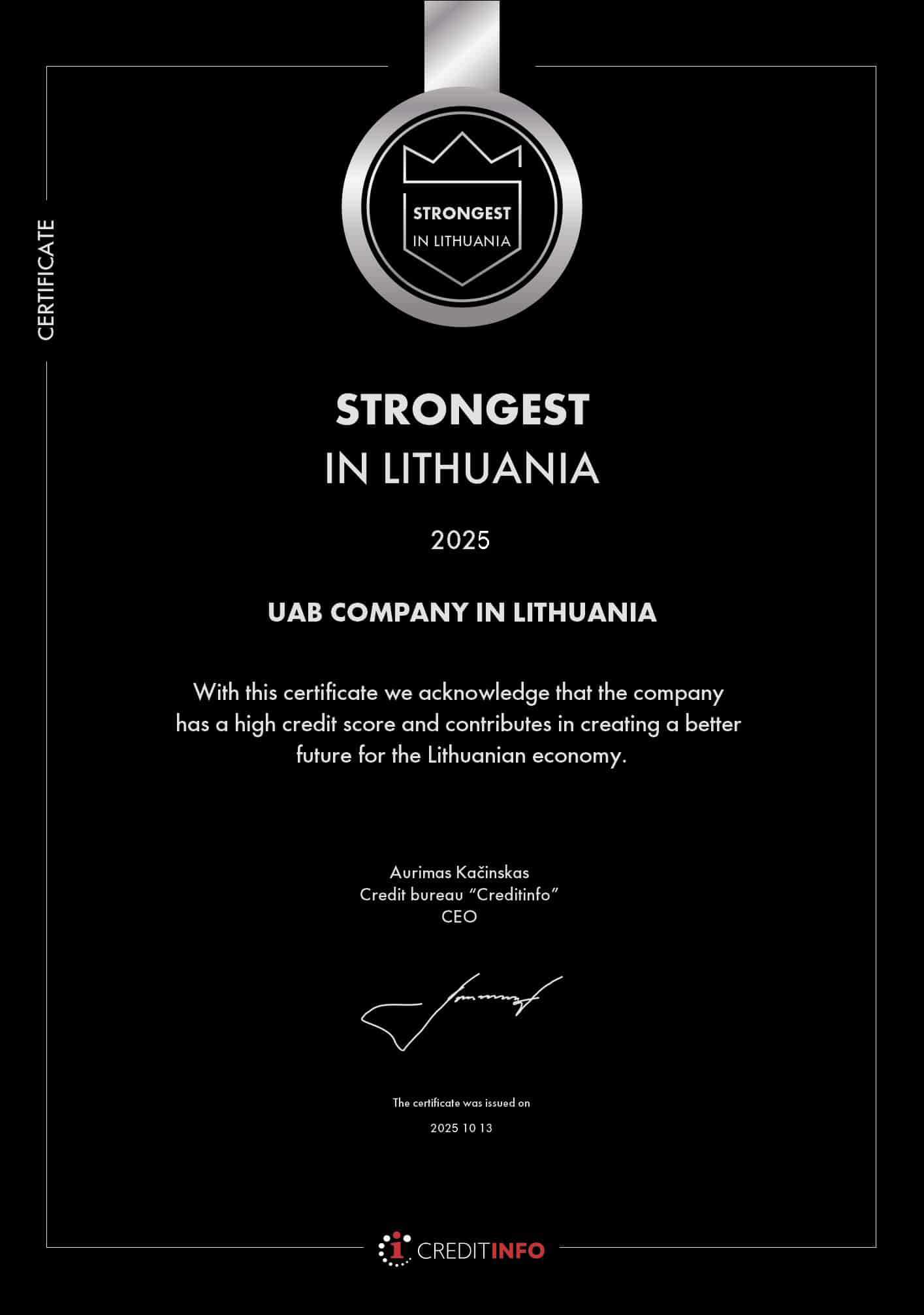
Company in Lithuania UAB pripažinta viena patikimiausių verslo paslaugų įmonių Lietuvoje. Remiantis nepriklausomais 2025 m. ekonominiais duomenimis, mums buvo suteiktas Stipriausi Lietuvoje ketverius metus iš eilės suteiktas apdovanojimas – tai liudija apie mūsų finansinį stabilumą, profesinį patikimumą ir klientų pasitikėjimą.
Prisidedame prie skaidrios ir gerai veikiančios verslo aplinkos Lietuvos Respublikoje ir taikome tą patį sąžiningumo standartą kiekvienam klientui.
Pasiruošę pradėti verslą Lietuvoje?Susisiekite su mūsų komanda jau šiandien ir gaukite individualią konsultaciją. Padėsime, kad procesas būtų paprastas, greitas ir sklandus.Susisiekite su mumis
Populiarios paslaugos