

Company in Lithuania UAB – Praktikos sritys – Finansinės licencijos Lietuvoje – Kriptovaliutų licencija Lietuvoje
Kriptovaliutų licencija Lietuvoje

Lithuania is one of the leading EU jurisdictions for crypto businesses. Since 30 December 2024, crypto-asset services in Lithuania are governed by the EU Markets in Crypto-Assets Regulation (MiCA, Regulation (EU) 2023/1114) and the Law on Crypto-Asset Markets of the Republic of Lithuania. To provide crypto-asset services, a company needs a crypto-asset service provider (CASP) licence issued by the Bank of Lithuania.
The former registration regime for virtual currency exchange and wallet operators under the supervision of the Financial Crime Investigation Service (FCIS) ended on 1 June 2025: since then, crypto-asset services in Lithuania may only be provided with a CASP licence. A licence issued in Lithuania allows the company to serve clients in all EU/EEA countries (MiCA passporting). A detailed overview of the regime: MiCA licencija Lietuvoje.
Privalumai
 The CASP authorisation procedure is governed by Article 63 of Regulation (EU) 2023/1114. The competent authority generally assesses the completeness of an application within 25 working days and, once the application is complete, assesses it within 40 working days, subject to permitted extensions and requests for additional information. The preparation of a complete application, including governance, compliance, capital and operational documentation, may require additional time. Obtaining a CASP authorisation within one month cannot be guaranteed.
 A CASP seeking authorisation in Lithuania must satisfy the substance and governance requirements established by MiCA, including maintaining a registered office in the relevant EU Member State, effective management within the European Union and genuine operational arrangements. Under Article 59 of MiCA, an authorised CASP must have its place of effective management in the EU and at least one director resident in the EU. A Lithuanian registered address or virtual office alone does not demonstrate sufficient operational substance or regulatory compliance.
 Applicants for CASP authorisation must maintain the prudential safeguards required by Article 67 of MiCA. These must equal at least the higher of the applicable permanent minimum capital requirement or one quarter of the fixed overheads of the preceding year, subject to the Regulation’s provisions for newly established entities. Depending on the services provided, the minimum capital requirement is EUR 50,000, EUR 125,000 or EUR 150,000. Prudential safeguards may be maintained through eligible own funds, qualifying insurance or comparable guarantees, or a permitted combination. A UAB must also comply with its separate statutory share capital requirements.
 The establishment or acquisition of a Lithuanian company may be completed remotely where the applicable identification, electronic signature and representation requirements are satisfied. However, CASP authorisation involves a substantive regulatory assessment of shareholders, management, governance, operational infrastructure, capital adequacy and compliance arrangements. The Bank of Lithuania may request interviews, additional documentation or other verification measures. Fully remote completion of every stage of the authorisation process cannot be guaranteed.
CASP licence in Lithuania under MiCA
Lithuania operates under the EU Crypto-Asset Service Provider (CASP) authorisation framework established by Regulation (EU) 2023/1114 (MiCA). CASP authorisation may cover one or more regulated services, including custody and administration of crypto-assets on behalf of clients, operation of a trading platform, exchange of crypto-assets for funds or other crypto-assets, execution of orders, placement of crypto-assets, reception and transmission of orders, advice, portfolio management and transfer services.
The services covered by an authorisation depend on the applicant’s business model and the approval granted by the Bank of Lithuania. The former separate national registration categories for cryptocurrency exchanges and custodial wallet operators no longer provide sufficient authorisation to conduct regulated crypto-asset services.
The Lietuvos bankas is the competent authority responsible for granting CASP authorisations under MiCA and supervising compliance with the applicable regulatory requirements. The Financial Crime Investigation Service (FNTT/FCIS) also performs supervisory functions concerning anti-money laundering and counter-terrorist financing within its statutory competence. Registration with the Centre of Registers or the Financial Crime Investigation Service does not replace CASP authorisation.
KRIPTOVALIUTOS LICENCIJA KAINA
|
PAKETAS «ĮMONĖS IR KRIPTOVALIUTOS LICENCIJA LIETUVOJE» |
PAKETAS «ĮMONĖ IR KRIPTOVALIUTOS LICENCIJA LIETUVOJE» ĮSKAIČIUOTAS:
- Paruoštos įmonės pirkimas arba steigimas
- Assistance with the initial capital required under MiCA (EUR 50,000, 125,000 or 150,000, depending on the services)
- Teisiniai dokumentai įmonės steigimui
- Pagalbos teikimas Valstybinio socialinio draudimo fondo direktoriui užimtumo, pažinkite savo klientą (KYC) ir pinigų plovimo prevencijos srityse
- Vienerius metus juridinis adresas bus „Vilniaus verslo centras“.
- Kriptovaliutų bendrovės verslo modelio ir struktūros analizė
- Pagalba kriptovaliutų bendrovėms atidarant banko sąskaitas
- Įmonių pažinimo savo kliento (KYC) / pinigų plovimo prevencijos (AML) procedūros ir jų procedūrinės taisyklės
- Preparation and submission of the CASP authorisation application and supporting regulatory documentation to the Bank of Lithuania in accordance with MiCA and applicable Lithuanian legislation. Separate corporate filings with the Centre of Registers and AML/CFT-related notifications must be completed where required by law.
- Įmonių vyriausybei mokami registracijos mokesčiai
- State fees related to the licensing
*The company can be established without travelling to Lithuania; during the licensing, the Bank of Lithuania may invite the managers of the company for an interview.
Papildomos paslaugos
| Paslauga | Kaina |
|---|---|
| 150 EUR/val. | |
| 1 000 eurų | |
| 2 000 eurų | |
| 3 000 eurų |
Lietuvoje registruotos kriptovaliutų biržos




Lithuania crypto licence requirements under MiCA (2026)
Since 30 December 2024, Regulation (EU) 2023/1114 on markets in crypto-assets (MiCA) applies directly in Lithuania, together with the Law on Crypto-Asset Markets adopted on 11 July 2024 and the licensing rules for crypto-asset service providers approved by the Bank of Lithuania on 17 December 2024.
Main changes compared with the former VASP regime
- Since 1 January 2026, companies intending to provide regulated crypto-asset services in Lithuania must generally obtain CASP authorisation under MiCA before commencing operations, unless they qualify for the specific arrangements available to certain authorised financial institutions under Article 60 or another applicable exemption. The Bank of Lithuania is the competent licensing authority. The Centre of Registers remains responsible for corporate registration and related statutory information systems but does not grant CASP authorisation.
- Companies registered as virtual currency exchange or wallet operators could continue their activities only until 1 June 2025 (five-month transitional period)
- CASP prudential requirements are determined by Article 67 and Annex IV of MiCA. The permanent minimum capital requirement depends on the type of regulated crypto-asset services provided:
- EUR 50,000 – Class 1 services.
- EUR 125,000 – Class 2 services, including custody and administration of crypto-assets and exchange services.
- EUR 150,000 – Class 3 services, including operation of a crypto-asset trading platform.
The applicable prudential safeguard must equal at least the higher of the relevant minimum capital amount or the prescribed fixed-overheads requirement. These requirements should not be confused with the minimum authorised share capital of a Lithuanian UAB.
- Stricter requirements for governance, the management body, qualifying shareholders, safekeeping of client assets, ICT security and complaints handling
- A licence issued in Lithuania is valid in all EU/EEA countries (passporting)
Licensing timeline
Under Article 63 of MiCA, the Bank of Lithuania assesses whether an application is complete within 25 working days and takes a decision within 40 working days after receiving a complete application; requests for additional information suspend these periods. According to the regulator, the full licensing process may take four to five months in practice. Before the official submission, a draft application can be sent for a pre-assessment, with feedback within five working days.
Minimum capital and key requirements for a CASP
Own funds
A crypto-asset service provider must at all times hold own funds equal to the higher of the permanent minimum capital of its class or one quarter of its fixed overheads of the preceding year (Article 67 of MiCA). Own funds may consist of Common Equity Tier 1 capital, an insurance policy or a comparable guarantee, or a combination of them.
Governance and substance
Members of the management body must be of sufficiently good repute and have appropriate knowledge, skills and experience; at least one of the directors must be resident in the EU. Shareholders with qualifying holdings are assessed by the Bank of Lithuania. The company must have effective governance, internal control and risk management, a business continuity plan and ICT security arrangements in line with the Digital Operational Resilience Act (DORA, Regulation (EU) 2022/2554).
Protection of client assets
Crypto-assets and funds of clients must be segregated from the company’s own assets. Custodians keep a register of client positions and a custody policy. A complaints-handling procedure and clear disclosure of fees and risks are mandatory.
Prevention of money laundering
A crypto-asset service provider remains an obliged entity under the Law on the Prevention of Money Laundering and Terrorist Financing of the Republic of Lithuania: it identifies clients, monitors transactions, appoints a responsible officer and reports suspicious transactions to the Financial Crime Investigation Service (FCIS). Since 30 December 2024, the travel rule (Regulation (EU) 2023/1113) applies to all transfers of crypto-assets.
Reikalavimai pareiškėjai įmonei
Kriptovaliutų bendroves nuolat stebi atitinkamos teisinės institucijos, siekdamos užkirsti kelią nusikalstamu būdu gautų pajamų legalizavimui. Bendrovių savininkai ir valdybos nariai privalo turėti nepriekaištingą reputaciją ir neturėti teistumo.
Įmonėms, teikiančioms paslaugas kriptovaliutų sektoriuje, taikomi šie reikalavimai:
- A Lithuanian company (UAB) with its registered office in Lithuania
- Initial capital of EUR 50,000, 125,000 or 150,000, depending on the services
- Savininkas taip pat gali būti valdybos nariu
- Management body of good repute with relevant knowledge and experience; at least one director resident in the EU
- AML/CTF officer and compliance function
- Business plan, governance, internal control and risk management documents
- Visiems klientams turi būti atliekami patikrinimai ir identifikavimo procedūros.
- Siekiant laikytis įstatymų, klientų duomenys turi būti saugomi su galimybe juos pateikti vyriausybei.
- Rizikos vertinimas ir vidaus kontrolė yra būtini įmonei
- Compliance with MiCA and supervision by the Bank of Lithuania
Owners of the company do not need to be residents of Lithuania, and the company can be established remotely; however, the management must ensure real activities (substance) in Lithuania and in the EU.
Privalumai
Bendrosios nuostatos
 The application describes the crypto-asset services, the business plan, the governance arrangements and the policies required by MiCA. A CASP licence is issued only after the Bank of Lithuania has reviewed all documents and the company meets all licensing conditions.
After the licence has been granted, acquisitions of qualifying holdings are assessed by the Bank of Lithuania in advance; changes of the management body and other material changes must also be notified to the regulator.
CASP authorisation applications are reviewed by the Bank of Lithuania, which is the competent national authority under MiCA. Lithuania does not have a separate financial regulator called the Financial Conduct Authority of Lithuania. The Financial Crime Investigation Service (FNTT/FCIS) operates under the Lithuanian Ministry of the Interior and performs financial crime investigation and AML/CFT-related functions within its statutory competence. It is not a unit of the Lithuanian Border Police.
Crypto companies keep accounts and file tax returns like any Lithuanian company; in addition, licensed crypto-asset service providers submit regulatory reports to the Bank of Lithuania and provide client data to the supervisory authorities on request.
LICENCIJAVIMO PROCESAS
A Lithuanian UAB is a commonly used legal structure for obtaining CASP authorisation. Its minimum statutory share capital is EUR 1,000, but CASP applicants must additionally satisfy the prudential requirements established by MiCA, including the applicable EUR 50,000, EUR 125,000 or EUR 150,000 minimum capital threshold. Depending on the services and organisational arrangements, the applicant must also maintain adequate governance, compliance functions, operational infrastructure and financial resources. Incorporation of a UAB does not itself authorise the company to provide regulated crypto-asset services.
UAB kaip verslo forma Lietuvoje yra labai dažnai naudojama.
Uždaroji akcinė bendrovė (UAB) išvertus iš lietuvių kalbos reiškia uždaroji akcinė bendrovė. UAB įstatinį kapitalą sudaro akcijos, kurios gali būti parduodamos visiškai arba iš dalies, dovanojamos arba paveldimos. Bendrovėje turi būti ne mažiau kaip vienas savininkas (fizinis arba juridinis asmuo) ir ne mažiau kaip vienas direktorius (fizinis asmuo).
The CASP authorisation process in Lithuania generally involves the following stages:
- Assess the proposed crypto-asset services and determine the applicable MiCA authorisation category and prudential requirements.
- Establish or acquire an eligible Lithuanian legal entity and verify its shareholders and ultimate beneficial owners.
- Develop an appropriate governance structure, appoint suitable management and compliance personnel, and establish sufficient operational substance.
- Prepare the required business plan, financial projections, AML/CFT framework, internal controls, safeguarding procedures, ICT risk management arrangements and other regulatory documentation.
- Submit the authorisation application to the Bank of Lithuania under Article 62 of MiCA.
- Respond to requests for additional information and participate in the supervisory assessment.
- Commence regulated activities only after authorisation has been granted or another legally applicable route under MiCA has been satisfied.
The duration depends on the completeness of the application, the complexity of the business model and the regulator’s assessment.
KRIPTOVALIUTOS LICENCIJAI GAUTI TVARKA
Paraiškai reikalingi dokumentai
Kriptovaliutos licencijos paraiškos peržiūrai ir parengimui reikės šių dokumentų:
A crypto-asset service provider must appoint an officer responsible for the prevention of money laundering and terrorist financing. The officer does not have to be a Lithuanian resident but must have the knowledge, experience and good repute required for the position.
AML/KYC rules require licensed companies to keep detailed and up-to-date records of all clients and transactions and to provide them to the supervisory authorities on request.
Rizikos vertinimas, KYC/AML dokumentai ir procedūrinės taisyklės
Under the anti-money laundering (AML) and Know Your Client (KYC) requirements of Lithuanian law and MiCA, the internal procedures of the company must be prepared before applying for a CASP licence in Lithuania. The following are some examples:
Vidaus saugumo priemonės ir rizikos vertinimai
- Pinigų plovimo ir teroristų finansavimo vertinimas ir rizikos valdymas:
- Rizikos lygio nustatymas
- Rizikos klasifikacija
- Tautybė
- Sandorių kontrolės procedūros
- Lėšų kilmė
- Atitikties stebėsena ir vidaus auditas
- Deramo patikrinimo priemonės
- Pranešimo įsipareigojimai
- Informacijos apie įmonės sandorius ir klientus rinkimas ir saugojimas
- Įpareigojimo pranešti reguliavimo institucijai vykdymas
- Įmonės vidaus kontrolės taisyklės
Procedūrinės taisyklės, AML/KYC procedūros
- Mažesnės rizikos sandorių tvarkymo reikalavimų ir procedūrų nustatymas
- Apibūdinti sandorius, susijusius su didesne rizika, įskaitant komunikacijos ir vietos riziką. Operacijų vykdymas ir stebėsena pagal kitus parametrus ir atitinkamų reikalavimų bei procedūrų nustatymas.
- Atlikite deramą patikrinimą pagal šias taisykles
- Kliento tapatybės nustatymo dokumentų reikalavimai
- Gyvenamosios vietos adreso ir pragyvenimo šaltinio įrodymas
- Įmonės reikalavimų ir procedūrų, skirtų sandorių ir klientų duomenų saugojimui, aprašymas
- Reglamentai, susiję su reguliavimo pranešimais
AML/KYC pareigūnas
AML darbuotojo pareigos apima:
- Teikti pagalbą kuriant, įgyvendinant ir prižiūrint įstaigos pinigų plovimo prevencijos programą.
- Organizacija, renkanti ir analizuojanti informaciją apie įtartinus sandorius arba sandorius, kurie gali būti susiję su pinigų plovimu ar teroristų finansavimu.
- Reports on compliance with AML/CTF requirements are provided to the management of the company.
- Įtartinos veiklos tarp didelės rizikos klientų nustatymas ir pranešimas apie ją.
- Where suspicious transactions or activities may involve money laundering or terrorist financing, the company must submit the required suspicious transaction or activity report to the Lithuanian Financial Crime Investigation Service (Finansinių nusikaltimų tyrimo tarnyba – FNTT/FCIS) in accordance with Lithuanian AML/CFT legislation. FCIS is a Lithuanian authority and must not be confused with the United States Federal Bureau of Investigation (FBI).
- Užtikrinti, kad būtų sukurta visų produktų ir paslaugų, taip pat klientų ir užsakovų rizikos vertinimo sistema.
- Kitų darbuotojų AML mokymosi programos turėtų būti stebimos ir įgyvendinamos.
- Pagrindinis šių pareigų tikslas – teikti rekomendacijas ir ataskaitas apie AML vidaus politiką ir procedūras vyresniajai vadovybei.
- Išorinių organizacijų atitikties norminiams patikrinimams ir auditams organizavimas ir atlikimas.
KYC/AML pareigūnai taiko deramo patikrinimo priemones:
- Naujo kliento verslo santykiai turėtų būti užmegzti tinkamu būdu
- Grynaisiais pinigais sumokėta suma viršija 15 000 EUR arba atitinkamą sumą kita valiuta.
- Jei manote, kad gauta informacija nėra patikima, patikrinkite pateiktus dokumentus ar duomenis.
- Kai įtariamas pinigų plovimas ar terorizmo finansavimas
Compliance officers must meet the following requirements:
- Kad AML darbuotojas būtų paskirtas į šias pareigas, jis privalo turėti pareigoms atlikti reikalingą išsilavinimą, kompetenciją, gebėjimus, asmenines savybes, patirtį ir nepriekaištingą reputaciją.
- Darbuotojai, ypač tie, kurie atsakingi už klientų aptarnavimą ir operacijų kontrolę, turėtų gauti specializuotus mokymus apie pinigų plovimo ir terorizmo finansavimo prevenciją.
Be konfidencialių finansinių duomenų stebėjimo ir tvarkymo, atitikties specialistas taip pat reguliariai bendrauja su direktorių valdyba ir finansų institucijomis. KYC/AML nėra vienintelė sritis, kurioje jūsų įmonės vadovui reikia pakankamai įgaliojimų, kad jis galėtų veiksmingai atlikti savo pareigas. Kad AML specialistas pasiektų sėkmės, jis arba ji turėtų būti direktoriaus lygio ir turėti didelę patirtį šioje pramonės šakoje.
KRIPTOVALIUTOMIS PREKYBINANČIŲ ĮMONIŲ APMOKESTINIMAS LIETUVOJE
The taxation of crypto-asset businesses in Lithuania depends on the nature of their activities and transactions. Certain qualifying exchanges of cryptocurrency for traditional currency may be exempt from VAT, while other services, including advisory, technology, platform and administrative services, must be assessed separately under the applicable VAT rules.
From 1 January 2026, the standard Lithuanian Corporate Income Tax rate is 17%. Qualifying small companies may apply a reduced rate of 7%, while eligible newly established companies may benefit from a 0% rate during their first two tax periods, subject to statutory conditions.
Dividends paid to individual shareholders are generally subject to 15% Personal Income Tax. Dividends paid to corporate shareholders are subject to separate corporate taxation rules, including a potential participation exemption or treaty relief.
KRIPTOVALIUTŲ OPERACIJŲ APMOKESTINIMAS LIETUVOJE
Sandoriai virtualiomis valiutomis apmokestinami pagal jų pobūdį. Lygiai taip pat, kaip galima parduoti arba įsigyti vertybinį popierių, investiciją ar kitą valiutą, tiesioginių mokesčių nėra.
Prekių ir paslaugų pardavimas laikomas įprastu / reguliariu, net kai mokėjimas atliekamas virtualiomis valiutomis. Apskaitos tikslais sandoriai turi būti vertinami eurais, o PVM taisyklės taikomos pagal įprastą verslo praktiką. PVM netaikomas mokėjimams virtualia valiuta. Tai taip pat turėtų būti taikoma mokėjimams virtualia valiuta, jei PVM taikomas mokėjimams fizine valiuta. PVM deklaracijas būtina pateikti eurais, o PVM bus sumokėtas arba grąžintas eurais.
Bank of Lithuania and FCIS
The Bank of Lithuania licenses and supervises crypto-asset service providers under MiCA. The Financial Crime Investigation Service (FCIS) is the financial intelligence unit of Lithuania: it receives reports on suspicious transactions and investigates financial crime, including money laundering.
Company in Lithuania UAB bendradarbiauja su kiekvienu klientu individualiai ir dokumentus parengsime remdamiesi jūsų pateikta informacija. Prašome susisiekite su mūsų komanda, ir mes pasiūlysime Jums geriausią įmanomą sprendimą, atitinkantį Jūsų poreikius.
Dažnai užduodami klausimai
Yes. Lithuania grants Crypto-Asset Service Provider (CASP) authorisations under Regulation (EU) 2023/1114 (MiCA) and the Lithuanian Law on Crypto-Asset Markets. CASP authorisations are issued by the Bank of Lithuania. The former national regime for virtual currency exchange operators and custodial wallet providers ceased to be sufficient for providing regulated crypto-asset services on 1 January 2026. Applicants must satisfy the applicable prudential, governance, AML/CFT, safeguarding, operational resilience and organisational requirements.
To obtain CASP authorisation in Lithuania, an applicant must establish or acquire an eligible legal entity and submit an authorisation application to the Lietuvos bankas. The application must comply with Articles 62 and 63 of MiCA and the applicable implementing requirements. Notifying the Financial Crime Investigation Service or registering cryptocurrency-related activities with the Centre of Registers does not constitute CASP authorisation. The applicant must demonstrate adequate financial resources, suitable management, robust internal controls, appropriate operational infrastructure and compliance with all relevant regulatory obligations.
Yes. The Bank of Lithuania is the competent national authority responsible for CASP authorisation and prudential and conduct supervision under MiCA. The Financial Crime Investigation Service also performs AML/CFT supervisory functions within its statutory competence. Companies seeking to provide regulated crypto-asset services must engage with the Bank of Lithuania through the applicable authorisation procedure.
A CASP licence lists the crypto-asset services the company may provide: custody and administration of crypto-assets, operation of a trading platform, exchange of crypto-assets for funds or for other crypto-assets, execution of orders, placing of crypto-assets, reception and transmission of orders, advice, portfolio management and transfer services. The required minimum capital depends on the services chosen.
The first stage of obtaining CASP authorisation is to determine the proposed crypto-asset services and assess the applicable regulatory requirements. A Lithuanian UAB may be established with minimum authorised share capital of EUR 1,000, but the company must additionally satisfy the significantly higher MiCA prudential safeguards applicable to its activities. The CASP application must be submitted to the Bank of Lithuania. A notification to the Centre of Registers does not authorise regulated crypto-asset services.
Yes, non-residents of Lithuania may own a Lithuanian crypto company. Shareholders with qualifying holdings (10% or more) are assessed by the Bank of Lithuania, and non-residents provide an extended package of documents, including a certificate of no criminal record from the country of residence.
Yes, the management body may include non-residents of Lithuania, but at least one director must be resident in the EU. All members of the management body must be of sufficiently good repute and have appropriate knowledge, skills and experience.
Taip, kriptovaliutų licencijos prašančioms įmonėms turi būti atidaryta sąskaita Lietuvoje registruotoje finansų įstaigoje (viename iš Lietuvos bankų arba Lietuvoje registruotoje elektroninių pinigų įstaigoje). Į šią sąskaitą turi būti įneštas įmonės įstatinis kapitalas.
The minimum statutory share capital of a Lithuanian UAB is EUR 1,000. However, the prudential safeguards required for CASP authorisation under MiCA are substantially higher and depend on the services provided. The relevant permanent minimum capital requirement is EUR 50,000, EUR 125,000 or EUR 150,000. Applicants must demonstrate compliance with the applicable prudential requirements before authorisation is granted and maintain the required safeguards on an ongoing basis.
A CASP licence in Lithuania is issued for an indefinite period. It may be withdrawn if the company does not use it within 12 months, stops providing crypto-asset services for more than nine consecutive months or no longer meets the licensing conditions.
Ne, kriptovaliutų bendrovės įstatinį kapitalą galima įnešti tik pervedant pinigus iš savininko (savininkų) asmeninės sąskaitos į bendrovės sąskaitą viename iš Lietuvos bankų arba Lietuvoje registruotoje elektroninių pinigų įstaigoje.
Įstatinis kapitalas apmokamas piniginiu įnašu (banko pavedimu). Bendrovės savininkai įneša kapitalą, atitinkantį jų akcijos nominalią vertę (t. y. atitinkančią jų dalį įstatiniame kapitale). Mokėjimas atliekamas iš valdybos nario banko sąskaitos į bendrovės banko sąskaitą viename iš Lietuvos bankų arba Lietuvoje registruotoje elektroninių pinigų įstaigoje.
Įnešta suma gali būti panaudota jūsų įmonės komercinei kriptovaliutų veiklai, kai Lietuvos registrų centras patvirtins įmonės įstatinio kapitalo įmokėjimą.
The initial capital required for the planned crypto-asset services (EUR 50,000, 125,000 or 150,000) must be paid in before the licence application is submitted, as the Bank of Lithuania checks the company’s own funds. The paid capital can later be used to finance the company’s activities, provided that own funds do not fall below the required level.
The conditions for applying for a CASP licence are:
- Business plan and description of the crypto-asset services
- Governance, internal control, risk management and AML/CTF policies and procedures
- Initial capital of EUR 50,000, 125,000 or 150,000
- Management body of good repute, with at least one director resident in the EU
- Certificates of no criminal record of the directors and qualifying shareholders
- CVs of all key persons of the project
Lithuania provides a regulated framework for crypto-asset businesses under MiCA, offering eligible authorised providers access to the European Union market through the applicable cross-border notification procedures. CASP authorisation involves a comprehensive assessment of the applicant’s management, ownership, financial resources, operational arrangements, ICT security, AML/CFT controls and client protection procedures. Applicants should plan for a substantial preparation and regulatory review period rather than expecting authorisation within one month. Licensing outcomes depend on the Bank of Lithuania’s independent assessment and cannot be guaranteed.
Yes. The Bank of Lithuania supervises licensed crypto-asset service providers: it can carry out inspections, request information and documents and apply sanctions. Client and transaction data must be kept for the period required by law and provided to the supervisory authorities on request.
Yes, a director may be a non-resident of Lithuania, provided that at least one member of the management body is resident in the EU and all directors have the required knowledge, experience and good repute.
Crypto-asset service providers should take the following measures to prevent money laundering and / or the financing of terrorism: Identification of client/recipient of funds:
- Nustatymas, ar klientas veikia savo vardu, ar per atstovą
- Jei klientas veikia per atstovą, nurodant kliento atstovą
- Gavėjo – fizinio asmens – identifikavimas
- Kliento – juridinio asmens – identifikavimas
- Kliento, juridinio asmens naudos gavėjo, identifikavimas
- Informacijos apie klientą, juridinio asmens narį, rinkimas
- Informacijos apie juridinio asmens struktūrą ir veiklos pobūdį rinkimas; informacijos apie kliento verslo santykių su lėšų gavėju, fiziniu ar juridiniu asmeniu, tikslą ir numatytą pobūdį rinkimas
- Kliento ir gavėjo tapatybės patikrinimas remiantis dokumentais, duomenimis ar informacija, gauta iš patikimo ir nepriklausomo šaltinio
- Nuolatinis kliento verslo santykių stebėjimas
- Reguliarus dokumentų, duomenų ar informacijos, pateiktų nustatant kliento ir lėšų gavėjo tapatybę, peržiūrėjimas ir atnaujinimas
- Jei neįmanoma įvykdyti kliento ir lėšų gavėjo tapatybės nustatymo reikalavimų – sandoris sustabdomas, o jei neįmanoma užmegzti dalykinių santykių – bendradarbiavimo nutraukimas.
- Application of customer and recipient identification measures not only to new but also to existing clients of the company (clients who became clients of the company before the new requirements)
- Suspending suspicious transactions and reporting them to the Financial Crime Investigation Service (FCIS)
- Notice of crypto-asset exchange transactions or transactions in crypto-assets, if the amount of such monetary transaction or transaction is equal to or greater than EUR 15,000 or its equivalent in foreign or virtual currency, regardless of whether the transaction is in one or more related money transfers
- Išsamus sudėtingų arba neįprastai didelių sandorių tyrimas
- Informacijos saugojimas tam tikrą laiką
- Pareigūnų, atsakingų už pinigų plovimo ir (arba) terorizmo finansavimo prevencijos priemonių įgyvendinimą, skyrimas
- Personalo mokymas
- Vidinių sistemų, skirtų greitai reaguoti į Finansinių nusikaltimų tyrimo tarnybos prašymus saugiais kanalais ir užtikrinti visišką prašymų konfidencialumą, diegimas
- Nustatyti vidaus kontrolės politiką ir procedūras
Crypto-asset service providers identify and verify the client before establishing a business relationship, when carrying out occasional transactions, whenever there are doubts about previously obtained identification data and whenever money laundering or terrorist financing is suspected. Under Regulation (EU) 2023/1113 (the travel rule), information on the originator and the beneficiary must accompany every transfer of crypto-assets, regardless of the amount. Measures are applied on a risk-based approach (standard, enhanced or simplified due diligence); if the client cannot be identified, the provider refuses the transaction or the business relationship, and suspicious transactions are reported to the Financial Crime Investigation Service (FCIS).
Our company has extensive experience in crypto licensing in Lithuania and is ready to accompany you throughout the CASP licensing process under MiCA. We will help with the establishment or purchase of a company in Lithuania that meets the requirements of the regulator, prepare the business plan, policies, procedures, risk assessment and AML/KYC documents required by MiCA and communicate with the Bank of Lithuania. Also Company in Lithuania UAB can help in finding and employing a Lithuanian KYC/AML officer for your company and train it in customer identification requirements under the Law on Prevention of Money Laundering and Financing of Terrorism.It should be noted that the selected employee will be a member of your company only, which is in accordance with the non-competitive clause and will represent it with the regulator. In addition, our employees can choose an office that fully complies with your company’s requirements and help with opening a bank account to deposit capital and open an account for working with crypto exchanges. Company in Lithuania UAB specialistai mielai jus informuos apie visus naujausius Lietuvos teisės aktų pakeitimus ir visada pasiruošę atsakyti į visus jūsų klausimus.
The most common reasons for delays are incomplete or generic documentation, a business plan that does not match the actual business model, insufficient substance in the EU and managers or AML officers without the required experience. The Bank of Lithuania also pays close attention to the origin of the funds of the shareholders.
Banko sąskaitos atidarymas didelės rizikos įmonei, kuri yra kriptovaliuta, yra sudėtingas ir jautrus klausimas. Verta atsižvelgti į tai, kad ne kiekvienas Lietuvos bankas bendradarbiauja su tokios veiklos įmonėmis, o nusipirkti įmonę su atidaryta banko sąskaita neįmanoma. Mūsų įmonė turi partnerių bankus visoje Europoje, kurie yra pasirengę dirbti su kriptovaliuta, ir mes mielai palydėsime savo klientus atidarant sąskaitą. Company in Lithuania UAB siūlo platų papildomų paslaugų spektrą, pavyzdžiui, Apskaitos paslaugos kriptovaliutų bendrovėms, mokesčių konsultacijos, finansinės licencijos (EPĮ, Mokėjimo įstaiga) ir pagalba įsidarbinant (KYC/AML pareigūnas). Mums svarbus individualus požiūris į kiekvieną klientą. Rūpinamės jūsų verslo poreikiais, derindami individualų užsakymų apdorojimą su profesionaliomis konsultacijomis, priimtinomis kainomis ir įmonių registravimo paslaugos Lietuvoje klientams iš viso pasaulio. Be to, Company in Lithuania UAB teikia paramą verslininkams pagal naujausias Lietuvos teisės aktų naujoves visą jų įmonių gyvavimo laikotarpį.
Papildoma informacija / BLOGAS:



Ar šis puslapis buvo naudingas? Įvertinkite
Įvertinkite šį puslapį pirmieji
Ačiū už įvertinimą!
Jūs jau įvertinote šį puslapį.
balsuotibalsaiCompany in Lithuania UAB partneriai








Company in Lithuania UAB bendradarbiauja su patikimų partnerių tinklu teisės, finansų, apskaitos ir verslo konsultavimo sektoriuose. Mūsų strateginės partnerystės leidžia mums teikti klientams kompleksinius sprendimus, susijusius su įmonių registracija, mokesčių konsultavimu, bankų steigimu ir kitais klausimais – visa tai po vienu stogu čia pat, Lietuvoje.
Stipriausi Lietuvoje
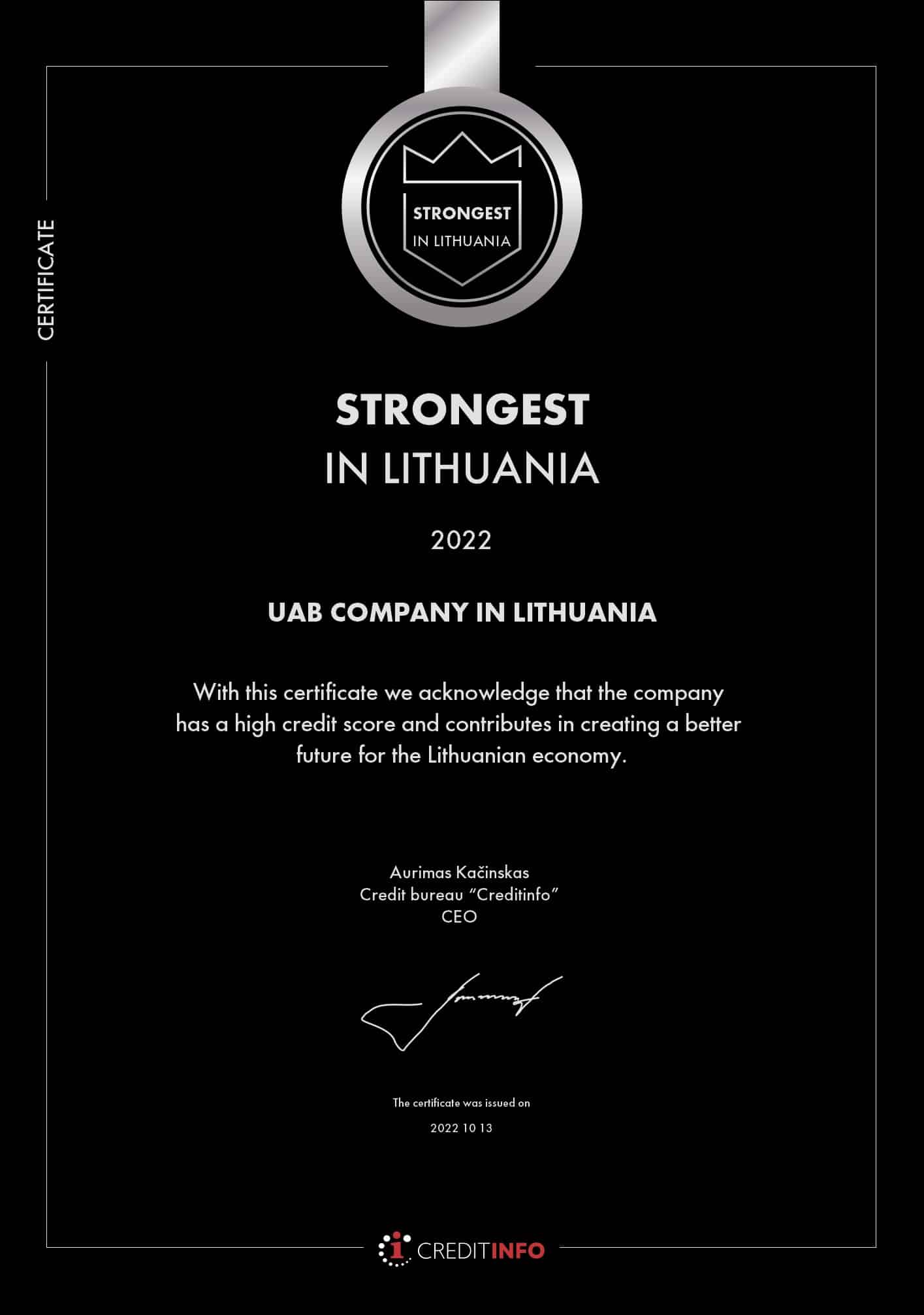
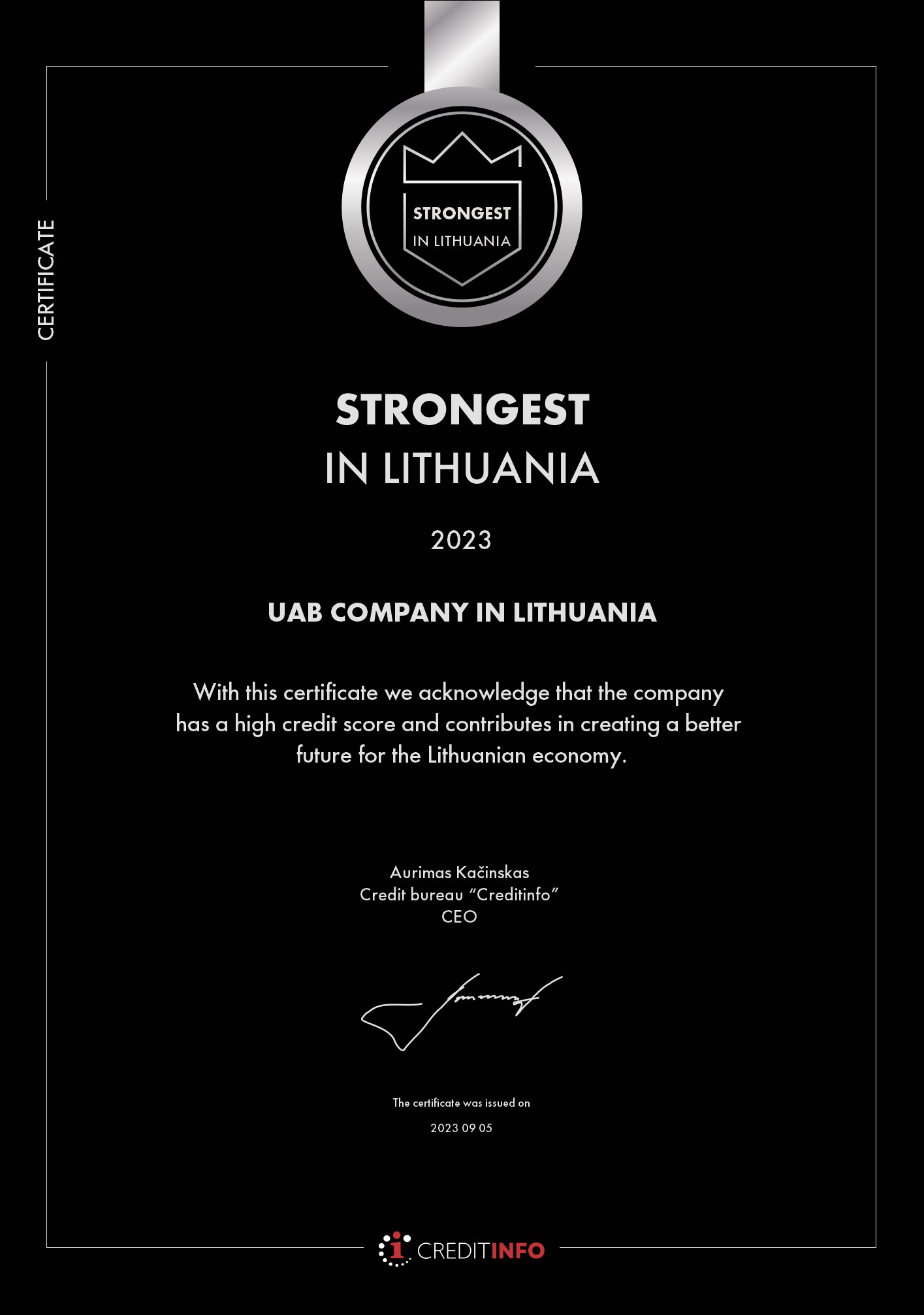

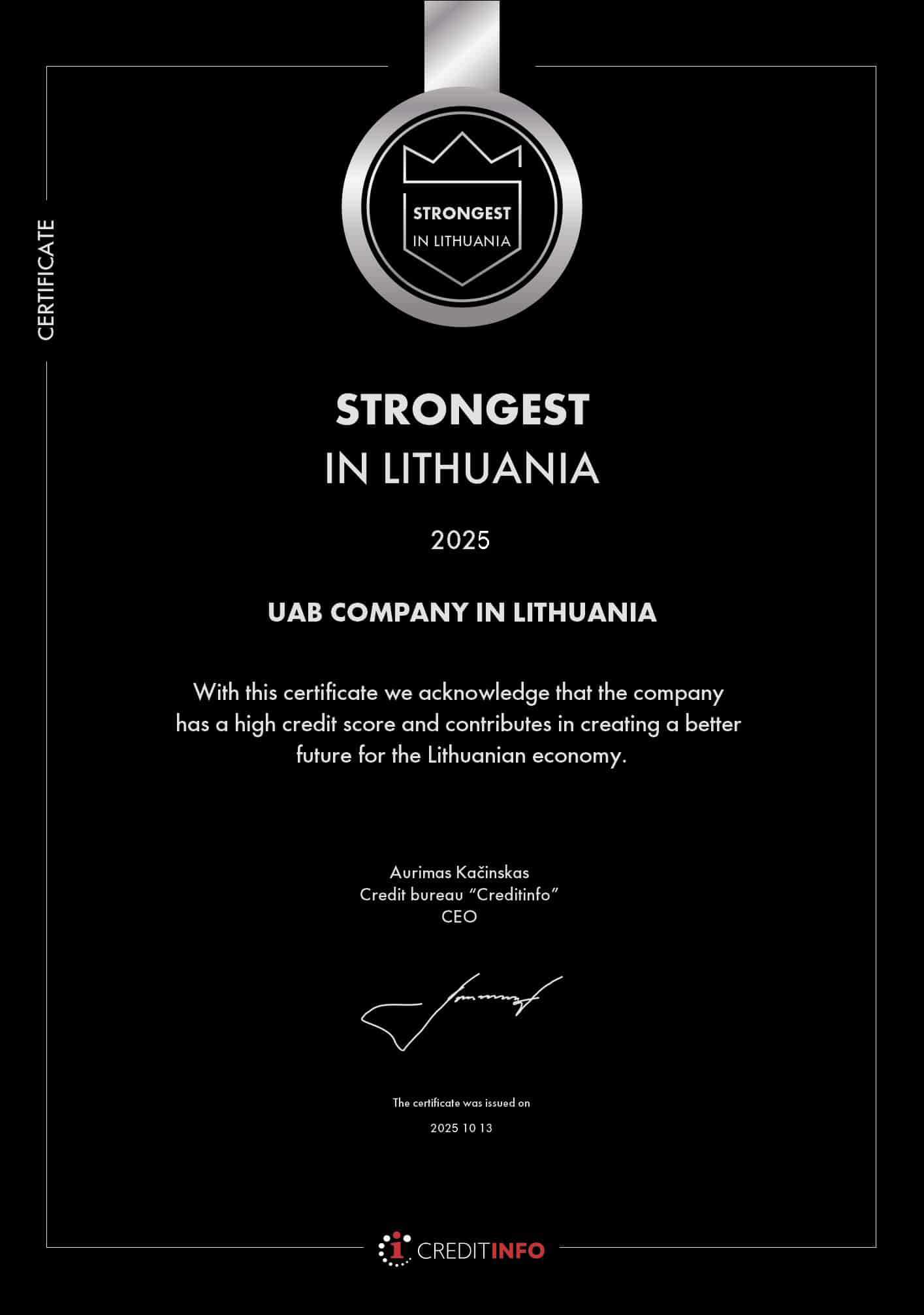
Company in Lithuania UAB pripažinta viena patikimiausių verslo paslaugų įmonių Lietuvoje. Remiantis nepriklausomais 2025 m. ekonominiais duomenimis, mums buvo suteiktas Stipriausi Lietuvoje ketverius metus iš eilės suteiktas apdovanojimas – tai liudija apie mūsų finansinį stabilumą, profesinį patikimumą ir klientų pasitikėjimą.
Prisidedame prie skaidrios ir gerai veikiančios verslo aplinkos Lietuvos Respublikoje ir taikome tą patį sąžiningumo standartą kiekvienam klientui.
Pasiruošę pradėti verslą Lietuvoje?Susisiekite su mūsų komanda jau šiandien ir gaukite individualią konsultaciją. Padėsime, kad procesas būtų paprastas, greitas ir sklandus.Susisiekite su mumis
Populiarios paslaugos